Want to see RevSure in action
Schedule a demo now
Book a Demo
Pipeline forecasting is entering a structural reset. For years, revenue teams have relied on pipeline volume, coverage ratios, and rep-driven forecasts to project outcomes. The result has been consistent: early confidence, late surprises, and end-of-quarter fire drills. By 2026, forecasting will no longer be about asking whether there is “enough pipeline.” It will be about knowing, early and continuously, what will convert, when it will convert, and what actions can still change the outcome.
Gartner’s Strategic Predictions for 2026 point to a clear shift away from static, human-interpreted forecasts toward AI-driven, probabilistic decision systems embedded directly into planning workflows. As business environments become more signal-dense and non-linear, manual forecasting models will struggle to deliver the early visibility leaders need.
At the same time, Gartner warns that as AI systems influence high-stakes decisions, explainability and governance become critical. Black-box automation introduces risk, making transparent models, clean data, and auditable predictions non-negotiable. For revenue leaders, this reinforces a core requirement: forecasting must deliver early certainty, not late explanations.
If forecasting in 2026 must deliver early certainty, GTM teams need more than dashboards and coverage ratios; they need actionable, predictive visibility into what will actually convert and where to intervene.
RevSure Pipeline Projections goes beyond reporting pipeline volume to model pipeline readiness, conversion likelihood, and future inflow across current and upcoming quarters. Instead of discovering gaps at the end of the quarter, teams see shortfalls early, while spend, generation, and execution can still be corrected.
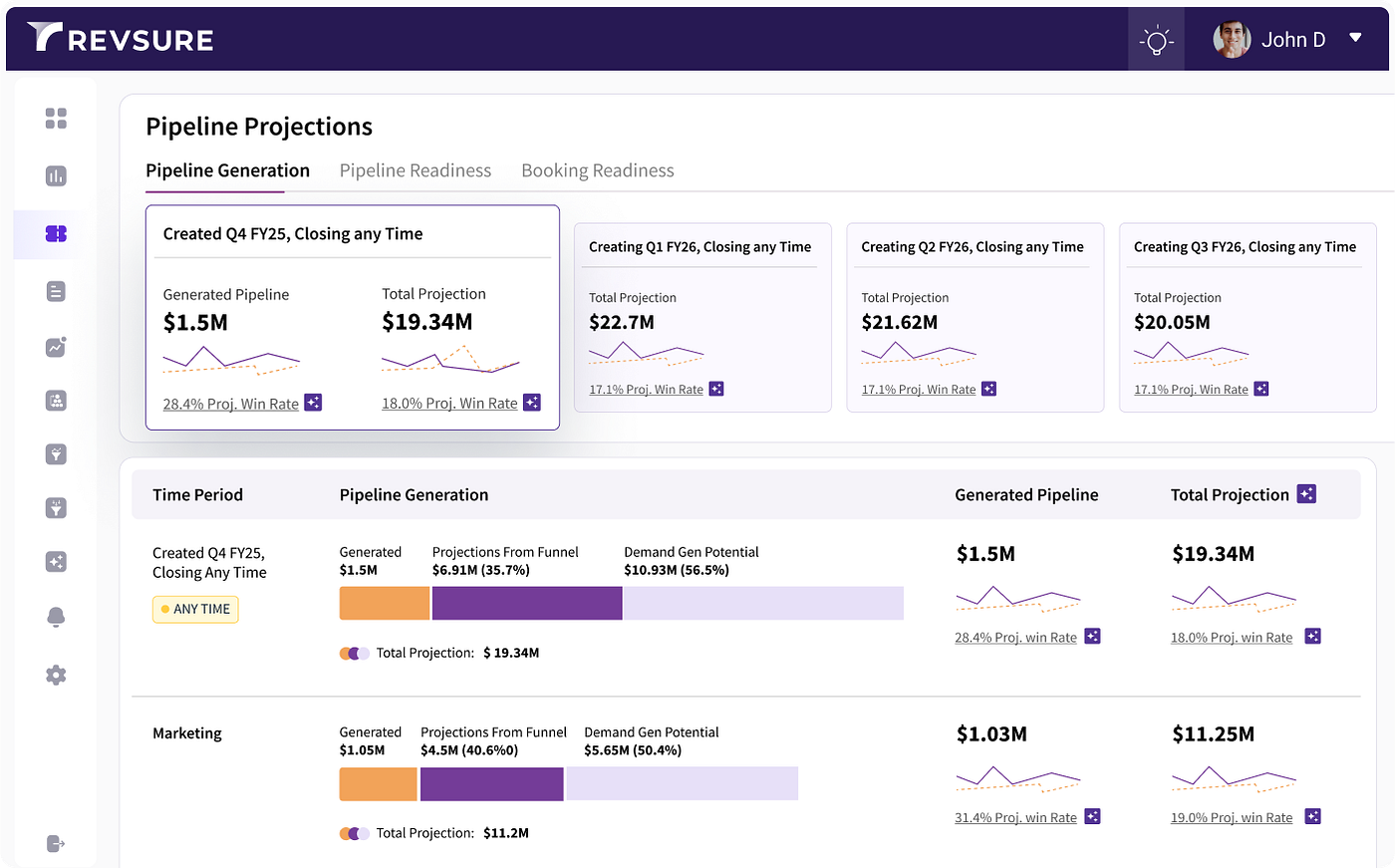
RevSure’s AI models learn daily from marketing, SDR, and sales signals to accurately project pipeline health, win rates, and bookings. The result is a shared view of revenue that helps teams prioritize the right deals, focus effort where it matters most, and commit to targets with confidence. In practice, this gives GTM teams the ability to:
RevSure turns forecasting into a daily operating advantage for revenue teams.
Pipeline volume often looks healthy until it doesn’t translate into revenue. In this blog, we break down why coverage ratios create false confidence, how CMOs get blindsided despite strong dashboards, and why predictability, not pipeline size, has become the real marketing KPI.
The piece explores how static forecasts and backward-looking metrics mask risk, why CMOs lack early warning when revenue is at risk, and how full-funnel visibility and transparent forecasting help marketing leaders shift from defending past performance to proactively shaping outcomes.
In this on-demand session, Jerry Henry and Francisco Garcia show how full-funnel predictability is operationalized inside RevSure. The webinar focuses on how predictive signals are modeled across marketing, SDR, and sales motions, how readiness is scored across stages and quarters, and how leaders can identify risk early enough to intervene.
Rather than revisiting theory, the session walks through real examples of forward pipeline modeling, probabilistic coverage views, and projection tracking, illustrating how teams move from insight to action within the quarter.
For those who want a broader view of what’s new across the platform, the November Product Release deep dive is now available on demand. This session covers recent updates across RevSure’s Full-Funnel AI platform, including the new MCP Server, expanded attribution flexibility, enhanced journey and probability intelligence, and upgraded AI-powered automation.
It’s a practical walkthrough of the latest capabilities and how they fit together across the GTM stack.
—
Forecasting in 2026 won’t be defined by bigger dashboards or louder opinions. It will be defined by systems that surface risk early, adapt continuously, and give leaders time to act. The teams that make this shift will stop reacting at the end of the quarter and start controlling outcomes long before it arrives.