Want to see RevSure in action
Schedule a demo now
Book a Demo
Over the past decade, B2B organizations have built increasingly complex GTM technology stacks. CRM systems manage pipeline, marketing platforms capture engagement, intent tools surface buying signals, and product analytics track adoption.
While each system provides valuable insight, the signals that drive revenue decisions remain distributed across multiple platforms. As a result, revenue teams often struggle to answer fundamental operational questions:
The challenge is not data scarcity. It is the lack of a unified operational context that connects buyer behavior, pipeline dynamics, and product engagement into a coherent revenue view.
This is where the Revenue CDP is emerging as a foundational layer in modern GTM architecture.
By integrating pipeline data, buying signals, product usage, and revenue outcomes, a Revenue CDP enables a Revenue 360 perspective that supports more accurate forecasting, account prioritization, and coordinated revenue execution.
In this issue of RevSure Horizons, we explore why the Revenue CDP is becoming a critical component of enterprise GTM infrastructure, and how it enables more signal-driven revenue operations.
Recent research highlights the growing importance of unified customer data in modern marketing architectures.
McKinsey notes that effective personalization increasingly depends on integrating customer data across systems and channels, enabling organizations to analyze behavior and activate insights consistently across touchpoints.

At the same time, the shift toward first-party data strategies is pushing companies to consolidate customer information into centralized environments that support analytics, governance, and engagement across teams.
Together, these trends point to a broader shift: organizations are investing in platforms that unify customer data across operational systems to support more coordinated marketing, sales, and customer engagement strategies.
Customer Data Platforms have made significant progress in helping organizations unify customer profiles and engagement data across systems. However, most CDP implementations were originally designed to support marketing activation and audience segmentation.
Revenue teams operate across a broader set of signals:
Without connecting these signals into a single context layer, organizations still struggle to understand where real revenue momentum is building across accounts and opportunities. This gap between customer data and revenue intelligence is driving the emergence of the Revenue CDP.
A Revenue CDP extends the traditional CDP model by connecting signals across the entire revenue lifecycle. Rather than focusing solely on customer profiles, a Revenue CDP integrates:
This unified signal layer enables revenue teams to move beyond isolated insights and operate with a Revenue 360 view of every account and opportunity.
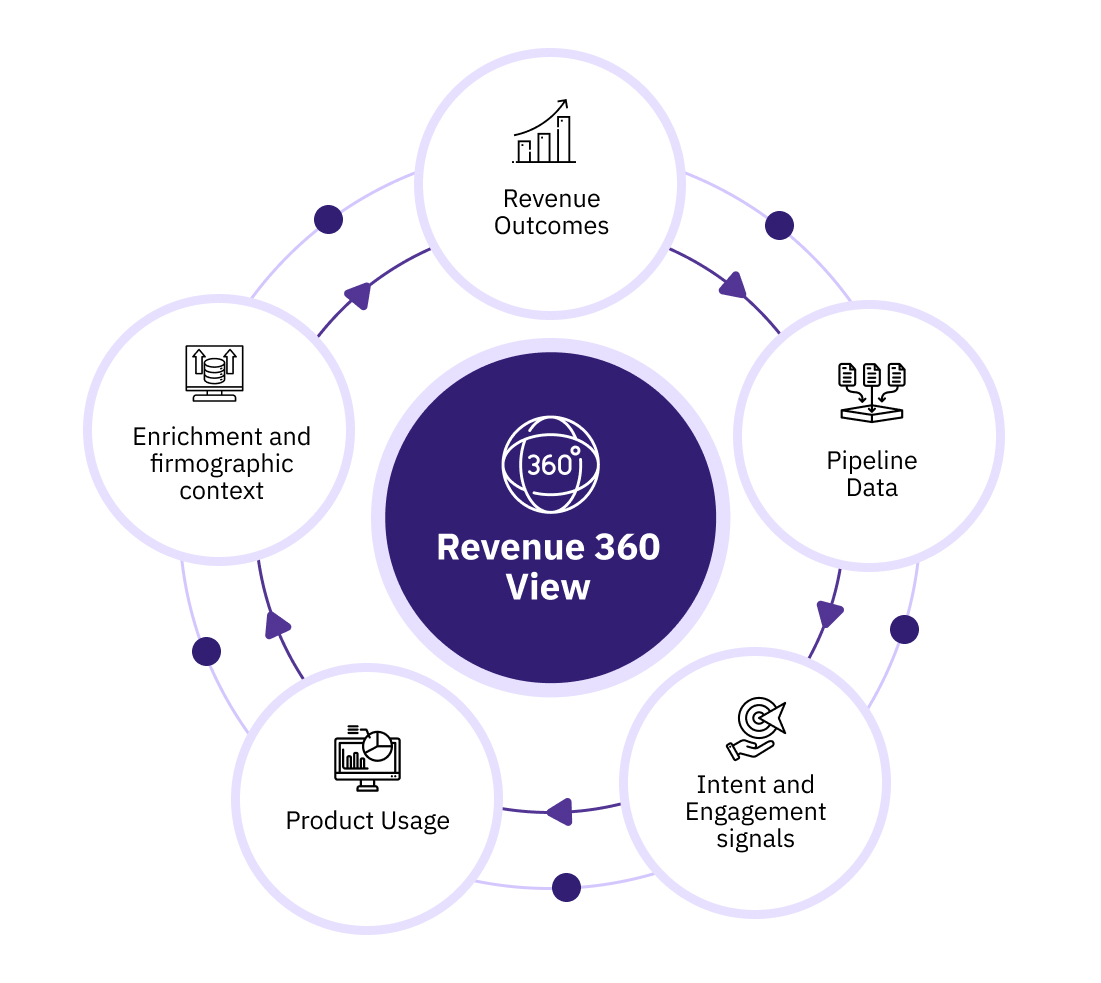
With this context, organizations can:
In effect, the Revenue CDP transforms fragmented data into operational intelligence for the revenue team.
As organizations move toward a unified revenue context, the Revenue CDP is emerging as a new architectural layer in the modern GTM stack. RevSure’s Full Funnel Context Data Platform operationalizes this architecture by connecting signals across the entire revenue lifecycle into a single system of record and system of action for GTM teams.
The platform integrates data from across the GTM ecosystem, including CRM systems, marketing automation platforms, intent providers, sales engagement tools, product analytics, advertising platforms, and more. These signals are continuously unified into a governed revenue context layer that serves as a single source of truth for revenue operations.

This unified foundation brings together:
Rather than analyzing pipeline, engagement, and product signals in isolation, revenue teams operate from a shared revenue context that connects customer behavior directly to pipeline progression and revenue outcomes.
This unified signal layer enables capabilities such as:
By transforming fragmented GTM signals into a coherent operational layer, RevSure enables revenue teams to move from reactive reporting to proactive revenue execution.
Most GTM teams don’t suffer from a lack of data; they struggle with fragmented signals spread across CRM updates, marketing engagement, intent spikes, product usage, and enrichment tools. In How Context Engineering Turns Fragmented Funnel Data Into Predictive GTM Intelligence, we explore how connecting these signals into a unified context layer transforms scattered activity into a predictive view of pipeline health and revenue momentum, enabling teams to move from reactive reporting to proactive, signal-driven execution.
Missed the live session? The recording is now available on demand. In this deep dive, Ram explains how RevSure operationalizes Marketing Mix Modeling (MMX) as a governed decision engine for enterprise B2B spend optimization. The session demonstrates how marginal ROI curves, saturation models, and scenario simulations translate model outputs into actionable investment decisions, aligning spend across regions, segments, and channels with pipeline coverage, ACV targets, and real-world business constraints.
Join us for a live walkthrough of RevSure’s February release, focused on helping GTM teams move from fragmented signals to governed execution. In this session, Vinay will highlight several key enhancements, including improved campaign channel classification for more accurate attribution, global dashboard filters for consistent reporting, and new integrations with Google Workspace and Breakout that transform meetings and conversations into actionable GTM signals. He will also introduce Agentic AI Account Action Plans, which translate insights into prioritized outreach and next steps for revenue teams
—-
The first generation of CDPs helped organizations unify customer data. The next generation of GTM infrastructure is focused on something more ambitious: unifying revenue signals. As AI-driven workflows become more central to sales and marketing operations, the need for a shared context layer will only increase. In that environment, the Revenue CDP becomes more than a data platform. It becomes the operating system for modern revenue teams.