Want to see RevSure in action
Schedule a demo now
Book a Demo
As go-to-market systems become more agentic, unified context is quickly becoming table stakes. Most GTM teams already capture rich signals across marketing, sales, and revenue operations, and many are connecting them into context graphs. But as AI shifts from insight to execution, a new challenge emerges: context alone isn’t automatically decision-ready. Autonomous systems don’t just need connected data; they need shared meaning.
In this issue, we explore why semantic layers are becoming foundational infrastructure for agentic GTM, translating trusted context into consistent, explainable decisions aligned with business intent.
Context graphs connect accounts, signals, decisions, actions, and outcomes; they show what is happening across the funnel. Semantic layers go further by defining what those connections mean in business terms. What qualifies as “high intent”? When is an account truly sales-ready? What defines pipeline risk or priority?
In traditional GTM systems, these definitions are often implicit and interpreted differently across teams. That ambiguity was manageable when humans made the decisions. Agentic AI removes that buffer. Autonomous execution requires shared definitions of intent, priority, readiness, and risk.
Without semantics, the same context can be interpreted inconsistently across systems, leading to unreliable decisions. Semantic layers turn connected data into decision-ready meaning.
Gartner Research Board’s research reinforces why semantic layers are becoming increasingly critical as AI systems move toward execution. In Rethink Semantic Layers to Support the Future of Analytics and AI (April 2025), Gartner highlights that analytics silos continue to create isolated insights, undermining trust and consistency across the organization.
As data use cases diversify and AI becomes embedded into operational workflows, Gartner points to semantic layers as a key component for unifying meaning across systems, ensuring that metrics, signals, and business concepts are interpreted consistently rather than differently across teams or tools.
Forrester’s research highlights a broader shift: semantic infrastructure is becoming foundational to the AI economy. In AI Powers A New Computing Ecosystem (October 2025), analysts Ted Schadler and Bill Martorelli describe how AI is reshaping enterprise stacks as systems move from automation toward AI-native decision and action.
In Forrester’s emerging AI computing model, the data layer increasingly becomes the knowledge or semantic layer, grounding AI agents in business meaning rather than raw signals. As agentic platforms expand, semantic layers become essential for making execution interpretable, predictable, and aligned with business logic.
Semantic layers define meaning, but in GTM, meaning must be operationalized directly into execution. RevSure’s Full Funnel Context Data Platform includes a purpose-built semantic layer configured to each organization’s unique GTM motion. It encodes shared definitions for lead, account, and opportunity lifecycles, intent classifications, prioritization frameworks, and GTM taxonomies.
This ensures that AI agents don’t operate on raw signals alone. They operate on a trusted context that has already been translated into consistent business meaning, enabling decisions that are explainable, repeatable, and aligned with GTM intent.
In other words, Context connects what is happening. Semantics defines what it means. Agentic systems execute accordingly.
Learn more about RevSure Full Funnel Context Data Platform
As AI begins triggering workflows and influencing revenue outcomes in real time, semantic clarity must also be governed. RevSure’s MCP Server serves as the secure gateway between trusted GTM context, semantic definitions, and autonomous AI agents. It ensures agents access unified identities, lifecycle semantics, and prioritization logic through a controlled, auditable interface.
Semantic layers define shared meaning. MCP Server ensures that meaning drives safe, consistent execution.

In an environment where AI can trigger workflows, reprioritize accounts, and influence revenue outcomes in real time, governance is not optional. MCP Server ensures that agentic execution remains consistent, explainable, and aligned to GTM intent, turning semantic clarity into controlled action.
Simply generating insights isn’t enough when AI starts to act autonomously. Systems need shared meaning to turn predictions into decisions. In Semantic Layers: The Difference Between AI Insights and AI Decisions, we explore why semantic layers are the bridge between raw AI output and actionable GTM execution. Unlike traditional data layers that deliver scores or signals, semantic layers encode business concepts like intent, priority, readiness, and risk, so autonomous systems can act with consistent interpretation across functions. This distinction is what transforms AI from a source of insight into a reliable partner in decision-making.
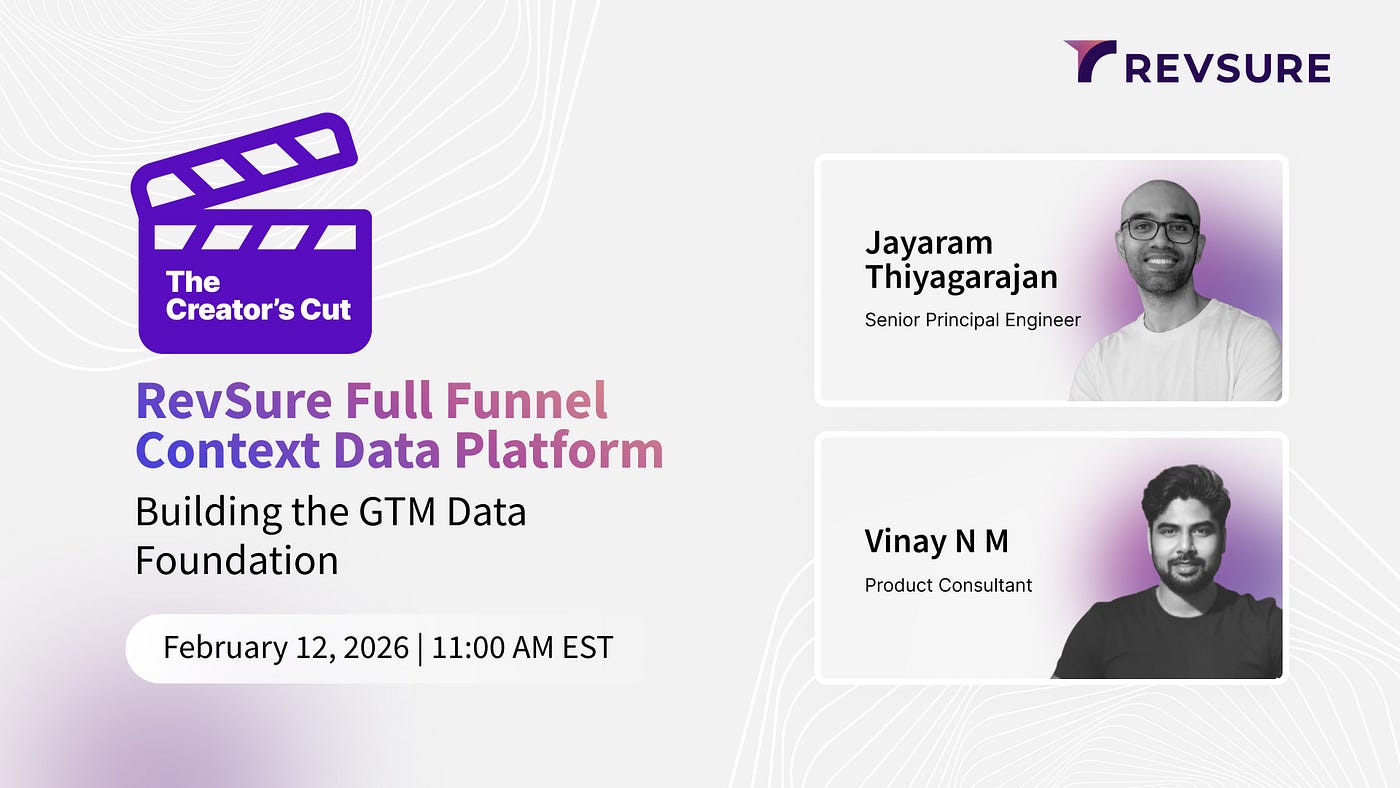
If you missed the live session, this deep dive into RevSure’s Full Funnel Context Data Platform is now available to watch on demand. Jayaram Thiyagarajan and Vinay N M walk through why GTM data often breaks down at activation, where disconnected systems, inconsistent records, and poor hygiene undermine attribution, reporting, and AI effectiveness, and how fragmented signals are standardized, harmonized, and governed into a single trusted foundation for real-time execution.
Unifying GTM data is only the first step. The real challenge is turning trusted context into real-time action across systems, workflows, and AI. In this webinar, Nishant Saikia and Shantanu Shrivastava demonstrate how RevSure enables real-time GTM orchestration through unified identity, event-driven workflows, safe writebacks, APIs, and MCP Server governance, activating full-funnel context for controlled execution across marketing, sales, and RevOps.

Agentic AI doesn’t fail because it lacks intelligence or context. It fails when systems don’t agree on what things mean. The next generation of GTM platforms will be defined by how well they encode intent, priority, and business logic into execution. Semantic layers are no longer optional; they are the bridge between understanding and action.