Want to see RevSure in action
Schedule a demo now
Book a Demo
As GTM systems become more agentic, accuracy depends less on algorithms or models and more on context. Most GTM stacks still rely on fragmented signals, like isolated events, disconnected accounts, and static attributes. Even advanced AI systems have to work with incomplete or conflicting information. As execution becomes more autonomous, this fragmentation turns from a minor issue into a real risk. Without a shared understanding of how signals, people, and outcomes connect, autonomy increases confusion instead of insight.
This is no longer just a theory. As context graphs shift from a new idea to real-world use, experts agree: AI systems need a shared, semantic understanding of the business to reason, explain, and act reliably.
In The Context Graph Manifesto, Daniel Davis and Mark Adams, who created TrustGraph, say that to get the most from AI, especially agentic systems, you need more than retrieval or embeddings. You need a dedicated context layer built for reasoning.
Based on years of work in semantic networks, graph theory, and AI, the authors define context graphs as graph structures built for AI that keep track of relationships, meaning, and changes over time. The manifesto points out that AI systems don’t fail from missing information, but from missing relational understanding. Without a shared, structured context layer, autonomous systems act fast but are fragile, focusing on fragments instead of the full picture.
Read the Context Graph Manifesto
In Context Graph: What It Is, How It Works, & Implementation Guide, Emily Winks, Data Governance Expert at Atlan, extends this thinking into enterprise data architecture. She explains how context graphs evolve beyond traditional knowledge graphs by incorporating temporal context, operational metadata, provenance, and decision traces.
By preserving how relationships change over time, and why decisions occur, context graphs enable AI systems to reason about cause and effect instead of reacting to isolated signals. This capability is essential for building autonomous systems that are accurate, explainable, and trustworthy at scale.
The value of context graphs is practical, not just theoretical. When GTM systems use a shared context layer, decision-making changes at a basic level. Signals aren’t just instructions anymore; they’re understood in the context of relationships, history, and the state of the business.
Context-aware GTM systems:
This is what separates reacting to events from reasoning about outcomes. Context graphs let agentic systems understand why something matters before they act, turning autonomy from a risk into an advantage.
Context-aware GTM needs more than just connected tools; it needs a connected model of reality. At the heart of RevSure’s Full-Funnel Context Data Platform is the Context Data Graph, a constantly updated, full-funnel graph that links accounts, buyers, interactions, signals, and outcomes into one reliable system of record.

Instead of seeing GTM data as separate events, RevSure shows how revenue is really created by keeping track of relationships among buyers, buying groups, pipeline stages, and outcomes over time. This strong context lets agentic systems reason about state, cause and effect, and impact, not just activity. Key capabilities include:
Together, these capabilities provide the context layer that agentic GTM depends on, allowing accurate prioritization, explainable decisions, defensible attribution, and scalable autonomous execution.
As agentic adoption speeds up, GTM organizations will shift from using dozens of tools to managing hundreds of agents. The focus will move from managing systems to managing coordination.
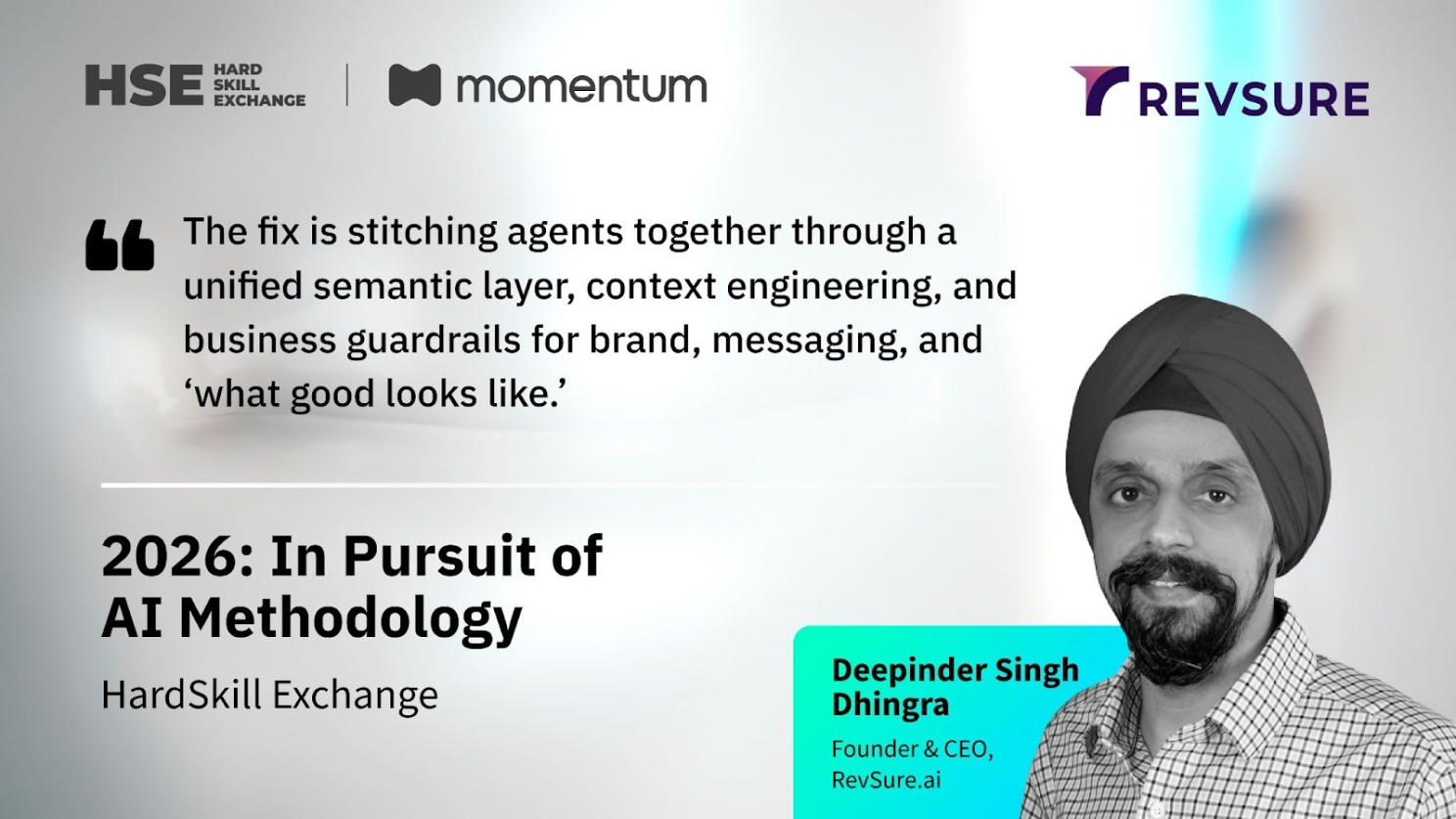
As Deepinder Singh Dhingra, Founder & CEO of RevSure, shared in 2026: In Pursuit of AI Methodology with HardSkill Exchange:
“Agentic adoption will jump from dozens of tools to hundreds of agents acting across millions of contacts. The risk is runaway automation and incoherent customer experiences when agents don’t share context nor coordinate. The fix is stitching agents together through a unified semantic layer, context engineering, and business guardrails for brand, messaging, and what good looks like. Coordinated AI beats more AI.”
As AI execution scales, coordination, not intelligence, becomes the limiting factor. Shared context is what brings together agents around the same understanding of the customer, the business, and desired outcomes.
Modern GTM systems generate endless data, but data alone doesn’t create understanding. In The GTM Context Graph, we explain why future revenue platforms will be built on context, connecting accounts, signals, actions, and outcomes into a unified graph that allows systems to reason about cause and effect. By preserving relationships over time instead of reacting to isolated events, context graphs enable agentic systems to prioritize accurately, act confidently, and scale execution without amplifying noise.
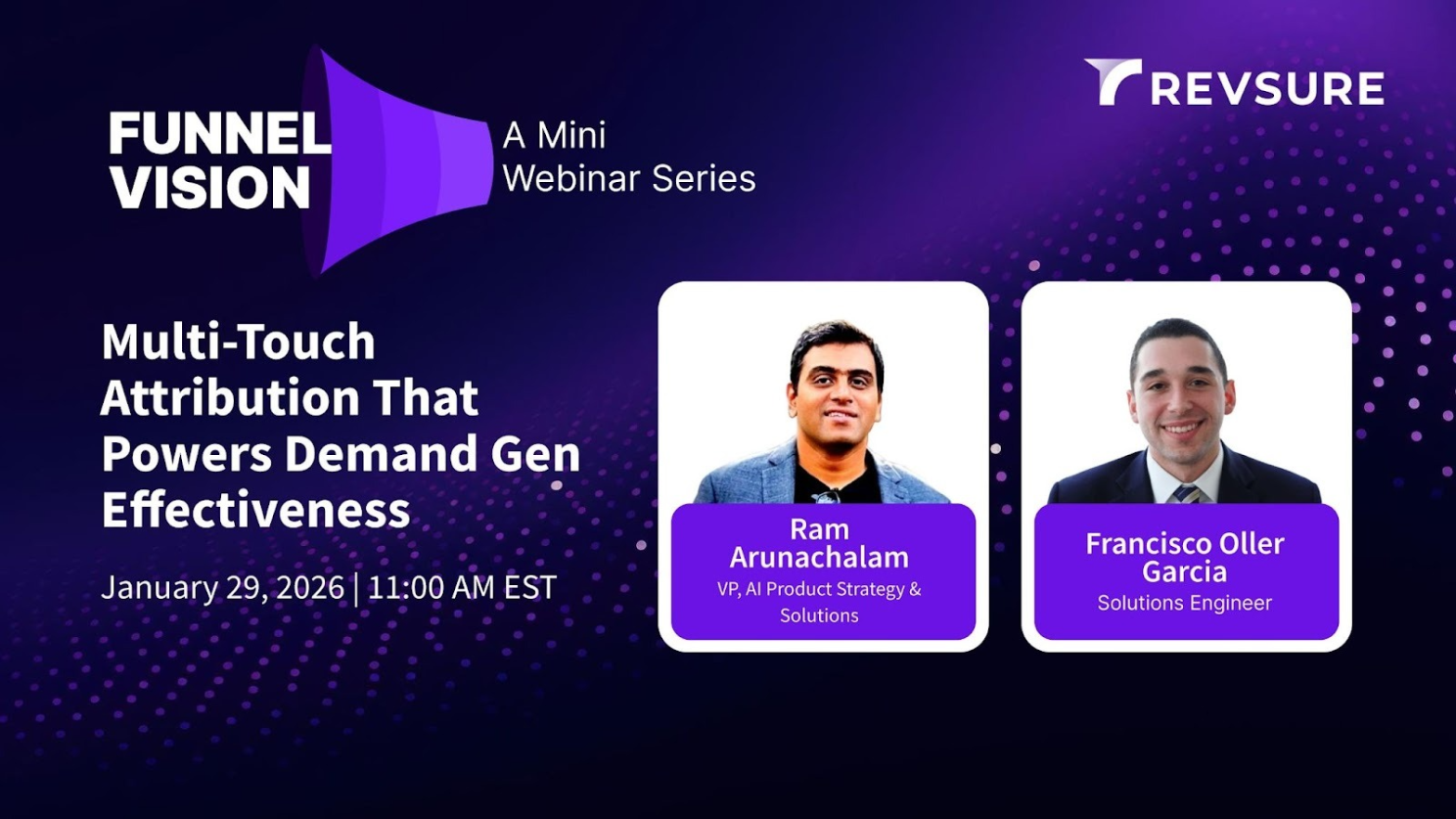
If you missed the live session, you can now watch this Funnel Vision webinar with Ram and Francisco on demand. They discuss how RevSure’s multi-touch attribution gives a single, managed view of demand performance by connecting every campaign, channel, and GTM motion to pipeline and revenue. You’ll see how full-funnel attribution helps teams prove ROI, optimize spending, and invest in what really drives growth.
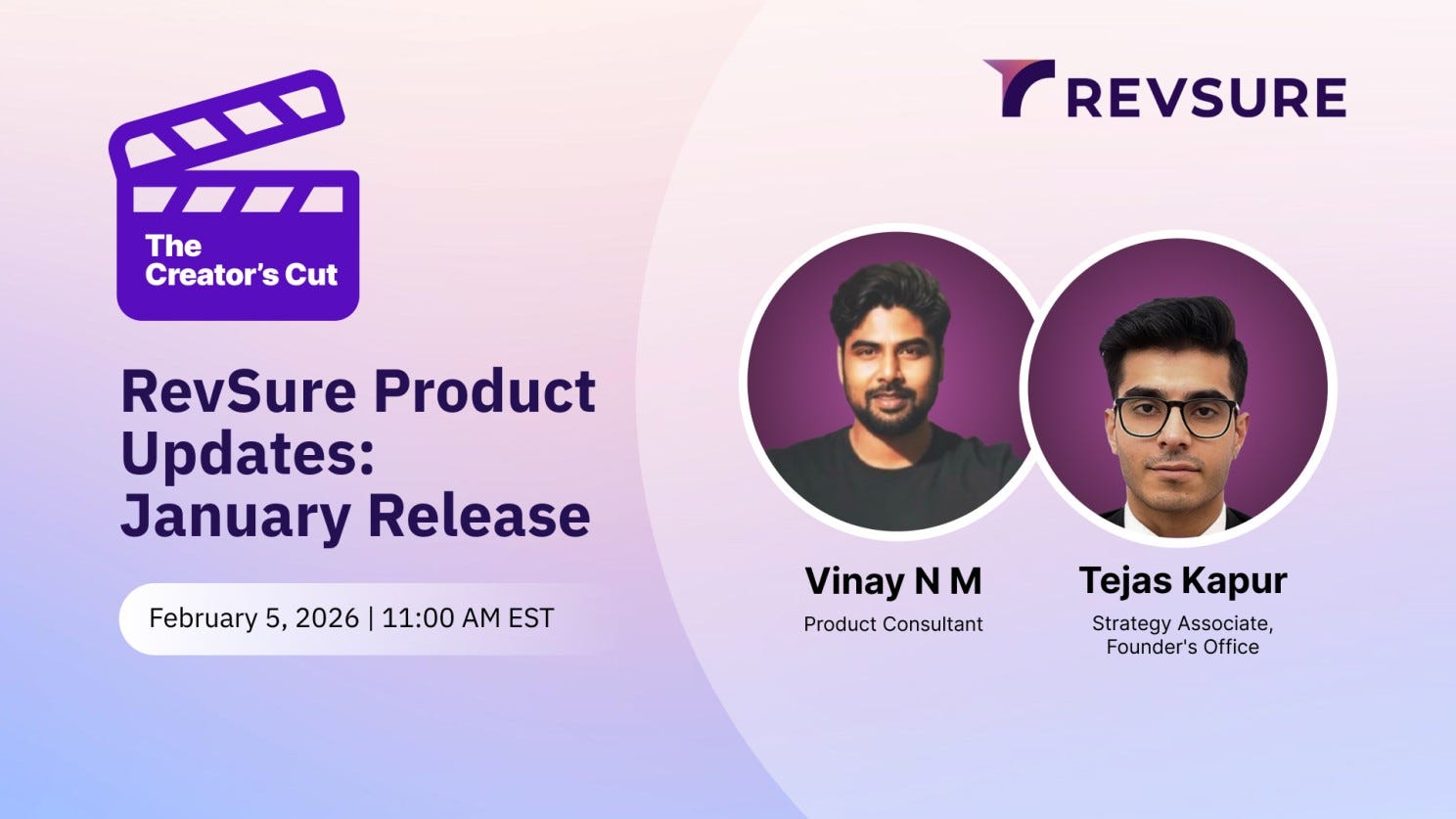
Join us for a live walkthrough of RevSure’s January product updates with Vinay N M and Tejas Kapur, focused on strengthening the GTM data foundation and improving how demand is captured, enriched, and activated across the funnel. The release includes new Navattic and Google Workspace integrations to unify demo and engagement signals with GTM data, Amazon Redshift as a data destination for downstream analytics, visitor-level prioritization and contact enrichment to surface intent earlier, and much more.
-
Agentic AI doesn’t fail because it lacks intelligence. It fails when it is missing context. The next generation of GTM systems will be defined not by how fast they act, but by how well they understand the relationships that shape outcomes. Context graphs are no longer optional; they are the substrate on which autonomous execution depends. In the future of GTM, context isn’t a feature. It’s the system.