Want to see RevSure in action
Schedule a demo now
Book a Demo


More than 90% of B2B buying journeys now begin before a buyer ever visits a vendor’s website. That single shift explains why last-touch attribution is quietly breaking down. For years, attribution models have tried to answer a deceptively simple question: What drove the conversion? The answer usually appears obvious. A buyer clicks a paid search ad, fills out a form, or requests a demo. The system records the final interaction and assigns credit to that channel.
Dashboards look clean. Reports feel decisive. Marketing teams get a clear explanation for what worked. But in modern B2B buying journeys, the final interaction is rarely the moment the decision was made. It is usually just the moment the decision becomes visible.
Everything that shaped that decision, the research, peer conversations, industry content, and brand exposure that influenced the buyer along the way, largely happens outside the scope of attribution models. The last click simply captures the outcome of a much longer process. In other words, attribution doesn’t measure marketing impact. It measures the last observable moment before a decision surfaces.
And in 2026, that moment is increasingly disconnected from the forces that actually created demand.
Over the past few years, B2B buying behavior has shifted away from environments that marketing platforms can easily track. The internet where attribution worked, where buyers moved predictably through measurable digital touchpoints, has evolved into something far more fragmented.
Today, buyers form opinions about vendors long before interacting with their websites or campaigns. Much of that learning happens in spaces designed for conversation, not measurement.
These interactions rarely generate attribution signals. They leave no cookies, no UTM parameters, and no clear touchpoints that marketing platforms can connect to revenue. By the time a measurable interaction appears, a search click, a demo request, or a form submission, the buyer often already has a shortlist of vendors in mind. The final interaction simply reflects a decision process that has been unfolding quietly for weeks or months.
Attribution models see the last click and assume causality. In reality, they are observing the final step of a decision that has already been shaped by dozens of unseen influences.
Another force accelerating the collapse of traditional attribution is the rise of AI-mediated research. Increasingly, B2B buyers rely on AI tools to synthesize vendor information before they ever engage with a company directly. AI assistants summarize categories, compare vendors, analyze documentation, and condense hours of research into a few paragraphs.
Instead of visiting dozens of websites, buyers now receive curated insights generated from multiple sources across the web. When a buyer eventually clicks a link or visits a vendor’s site, the decision process is already well underway. The click represents the conclusion of a research process that attribution platforms never observed.
Attribution models interpret that click as the cause of the conversion. But in reality, it is simply the first moment the system was able to record a decision that had already been influenced by a much broader ecosystem of information.
This shift fundamentally breaks the assumptions on which attribution models were built. They rely on observable touchpoints to explain outcomes. But increasingly, the most important influences occur outside those observable pathways.
Attribution models were designed for an earlier version of digital marketing, one defined by direct-response campaigns, shorter buying cycles, and relatively predictable funnels. In that environment, connecting a click to a conversion made sense. Buyers often discovered products through ads, visited a landing page, and completed a transaction within a short window.
B2B buying environments today look nothing like that. Modern purchase decisions involve extended evaluation cycles, multiple stakeholders, and an evolving set of information sources. Buyers move fluidly between research, discussion, validation, and internal consensus building.
Marketing impact accumulates gradually through repeated exposure, education, and credibility. A podcast conversation might spark curiosity. A blog post might shape category understanding. A peer recommendation might shift trust toward a specific vendor. None of these interactions exist as isolated triggers. They interact with one another, reinforcing and amplifying signals over time.
Trying to attribute a complex decision to a single touchpoint in this environment is like trying to explain a climate pattern by pointing to a single cloud. The model still produces an answer. It just doesn’t produce the right one.
The most dangerous aspect of attribution is not simply that it is incomplete. It is that it consistently tells marketing teams the same misleading story. Because attribution focuses on the final observable interaction, it repeatedly assigns credit to the channels closest to conversion. Late-stage channels appear to drive revenue while earlier-stage investments look inefficient.
Over time, this creates a familiar narrative inside marketing organizations.
This narrative feels rational because it is supported by data. But the data only measures what happens at the end of the buying journey. What attribution calls performance is often just demand capture, not demand creation.
Organizations gradually optimize for channels that harvest demand rather than the activities that generate it. Eventually, they find themselves investing heavily in conversion channels while pipeline growth becomes increasingly unpredictable. The problem is not execution. The problem is measurement.
A more accurate way to understand marketing impact is to shift from thinking about touchpoints to thinking about probability. Marketing rarely causes a single buyer to convert in isolation. Instead, it increases the likelihood that buyers will choose a company when a purchase moment emerges.
Brand investment increases the probability that buyers recognize the company and trust its credibility. Educational content increases the probability that buyers understand the problem the product solves. Consistent campaigns increase the probability that buyers engage when the timing becomes right.
These effects rarely appear as discrete conversion events. They reshape the environment in which decisions happen. Attribution models struggle with this because they attempt to isolate individual causes. But marketing impact is rarely isolated. It is cumulative, delayed, and interactive. Understanding marketing performance requires measuring how investments shift the probability of outcomes across the entire revenue system.
If marketing influence emerges from a system of interactions, measurement has to operate at the same level. Instead of focusing on isolated clicks or touchpoints, modern marketing measurement needs to analyze how investments interact across the entire revenue lifecycle, from first engagement to pipeline creation and closed revenue.
RevSure approaches this problem through an integrated measurement framework that combines multi-touch attribution, marketing mix modeling, and incrementality testing within a unified data environment. Together, these methods allow organizations to move beyond surface-level attribution and understand how marketing actually drives pipeline and revenue outcomes.
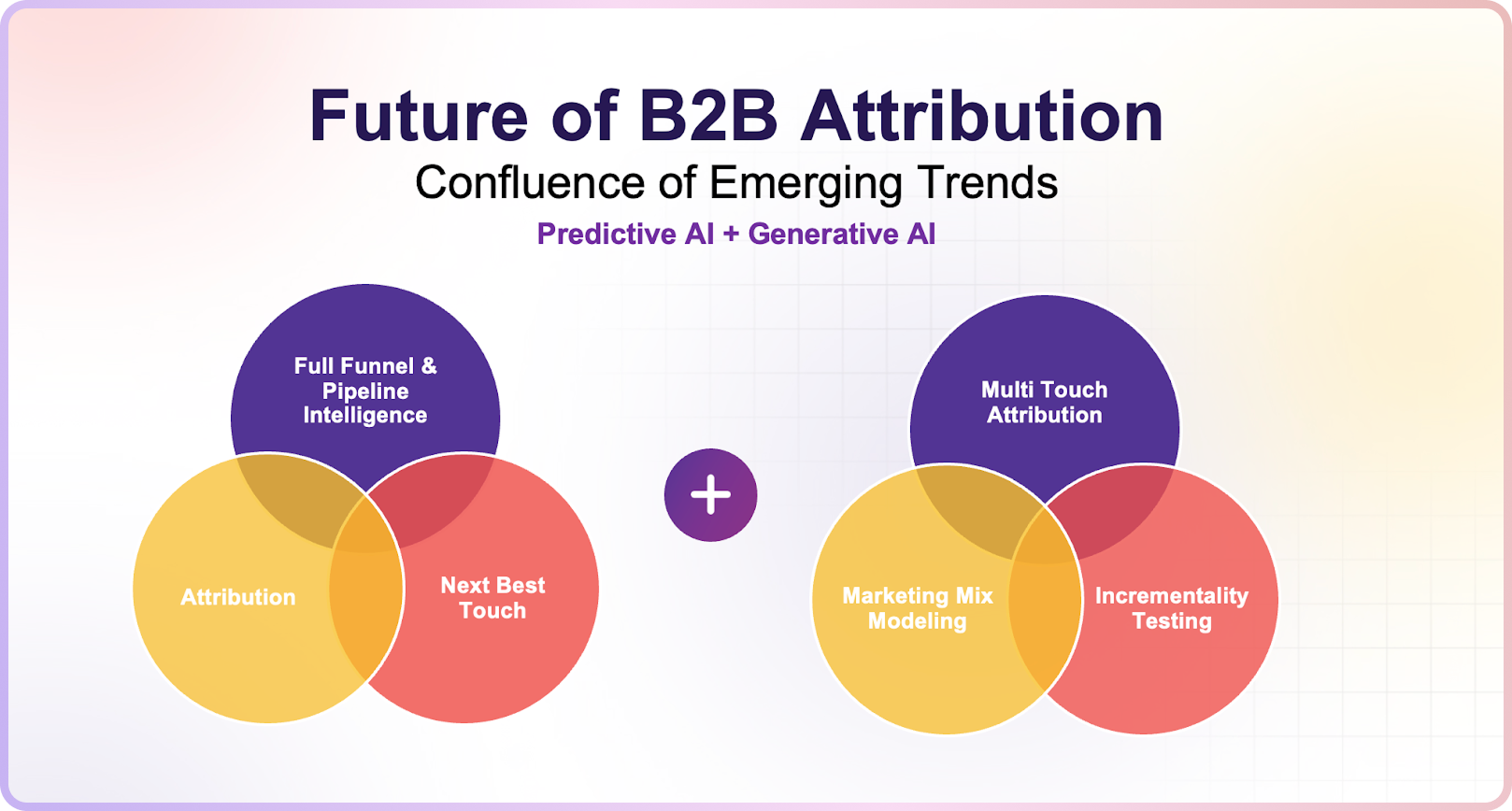
At the core of this approach is RevSure’s Full Funnel AI platform, which connects campaign activity, sales engagement, and revenue data through an interconnected GTM data graph. This unified data layer captures online and offline interactions across the entire buyer journey and allows AI models to analyze performance across channels, accounts, and funnel stages.
Once these signals are unified, RevSure’s AI engine applies multiple analytical models to understand how marketing investments shape outcomes over time. Marketing Mix Modeling evaluates the incremental impact of spend across channels, while attribution models analyze how specific campaigns influence stage progression throughout the funnel. Incrementality testing then validates which campaigns truly drive lift rather than just correlation.
Together, these capabilities reveal dynamics that traditional attribution systems cannot surface.
This shift fundamentally changes the question marketing teams ask. Instead of debating which channel deserves credit for a conversion, teams can understand which investments actually move pipeline forward and accelerate revenue.
And in a world where buying journeys are fragmented, AI-assisted, and increasingly invisible, that difference becomes the foundation for smarter budget decisions and more predictable growth.
Last-touch attribution answers a narrow question: where did the conversion happen. But that’s rarely the question marketing leaders actually need answered.
The real challenge is understanding what created the conditions for that conversion in the first place, the sequence of signals, exposures, campaigns, and conversations that gradually moved a buyer from awareness to action.
In modern B2B environments, those forces rarely come from a single channel. They emerge from a network of interactions across marketing, sales, community influence, and AI-mediated research. Measuring that kind of complexity requires a system designed to analyze the full revenue journey, not just the final click.
This is why marketing measurement is evolving beyond attribution alone. Organizations increasingly combine approaches such as Marketing Mix Modeling, multi-touch attribution, and incrementality testing to understand both how influence accumulates and which investments truly move pipeline and revenue.
Platforms like RevSure bring these capabilities together through a unified data foundation that connects campaign activity, pipeline behavior, and revenue outcomes across the full go-to-market motion. By analyzing these signals collectively, teams gain visibility into how marketing actually shapes growth, not just how conversions are recorded. Because in 2026, the organizations that win will not be the ones with the most dashboards. They will be the ones that understand how demand is created, how influence accumulates, and how marketing investments translate into revenue over time.