







EBook

The Future of B2B Attribution

The evolving landscape of B2B marketing has rendered traditional attribution methodologies inadequate, creating a disconnect between sales and marketing teams, and hindering actionable insights. A recent study shows that 74% of marketers struggle to accurately attribute revenue to their marketing efforts, while 65% report a significant misalignment between marketing and sales teams due to inconsistent attribution data. This ebook delves into the challenges of traditional attribution, highlights recent advances, and proposes a new comprehensive approach to transform attribution from mere measurement to actionable insights that drive business growth.
revenue operations Hero Image

Executive Summary

Challenges with Traditional Attribution
Current models justify past actions without providing clear next steps. They overlook the buyer journey, focus only on marketing campaigns, and ignore team synergies. Despite improvements like multi-touch attribution, gaps remain. Industry leaders demand a comprehensive view of cross-funnel conversions, detailed campaign insights, and simplified, actionable data for quick decisions.
Implementing the Future of Attribution
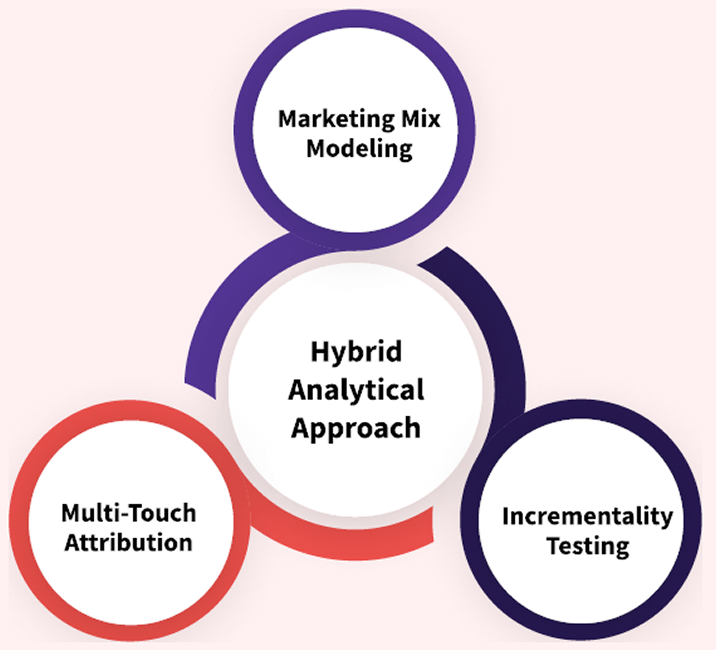
To address these limitations, it's essential to redefine key dimensions of attribution. Expanding the scope to full-funnel activities, shifting the focus to what maximizes pipeline and revenue, adopting a hybrid of Al-based multi-touch attribution and marketing mix modeling, transitioning to real-time, forward-looking insights, and providing actionable recommendations are all critical steps.
Implementing this new approach involves integrating data across the entire Go-to-Market (GTM) funnel, using predictive Al to identify effective campaigns, combining probabilistic multi-touch attribution with marketing-mix and incremental testing, leveraging near-real-time tracking, and providing prescriptive recommendations on next best actions.

Introduction

In B2B marketing, traditional attribution methodologies often prove inadequate, creating a disconnect between sales and marketing teams and limiting actionable insights.
Research shows that 74% of marketers struggle to attribute revenue to their marketing efforts accurately, and 65% report misalignment between marketing and sales teams due to inconsistent attribution data.
These challenges underscore the critical need for a more robust attribution system that not only measures but also drives actionable insights. This ebook explores the current challenges with traditional attribution, shares market feedback, and presents a new, comprehensive approach to transform attribution from mere measurement to true actionability.
We present a new, comprehensive approach to attribution that goes beyond traditional measurement techniques. Our methodology aims to bridge the gap between sales and marketing, enabling teams to collaborate more effectively and make data-driven decisions that enhance overall performance.

Traditional Attribution is NOT Working

There are several critical issues with traditional attribution methodologies that hinder their effectiveness. Firstly, there is a widespread distrust of attribution methodology. Many view these methods as mere tools for justifying past actions rather than providing actionable insights. This perspective diminishes the perceived value of attribution in driving strategic decisions.
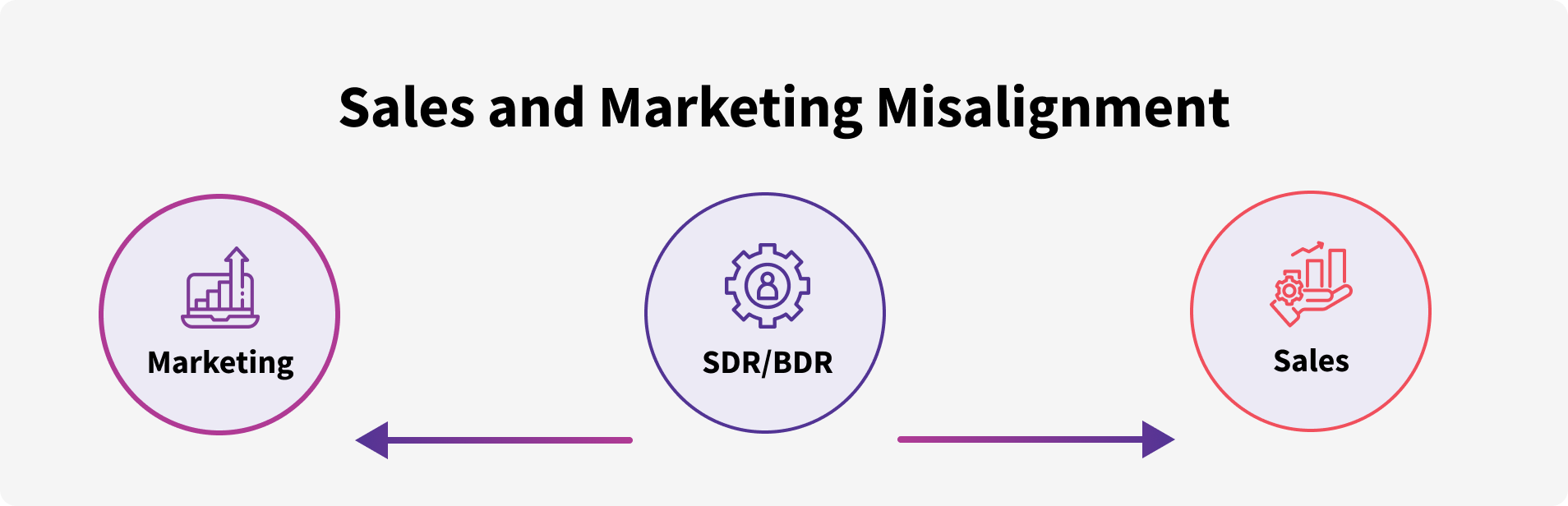
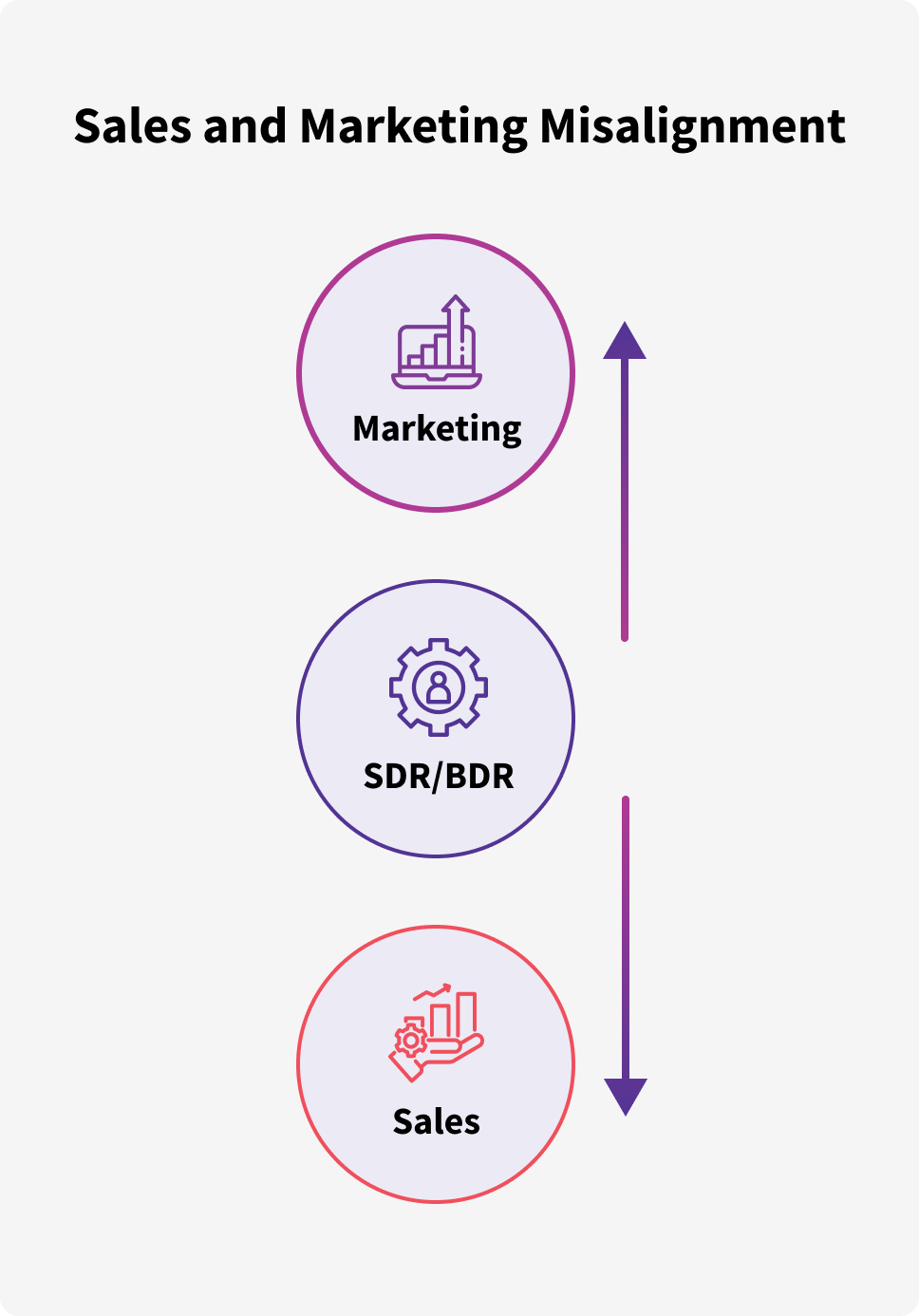
Additionally, traditional attribution is often seen as a justification mechanism, which exacerbates the problem of misalignment between sales and marketing teams. This misalignment, referred to as Attribution Wars, revolves around disputes over who should receive credit for conversions. Such conflicts divert focus away from collaborative efforts that could drive better business outcomes.
It is often seen as a justification mechanism, which exacerbates the problem of misalignment between sales and marketing teams.

Traditional Attribution Lacks Actionability

Moreover, traditional attribution suffers from limited actionability. It frequently fails to offer clear guidance on the next steps, leaving marketing teams uncertain about how to proceed after receiving attribution data. This lack of actionable insights hampers the ability to make informed decisions that could enhance marketing effectiveness and ROI.
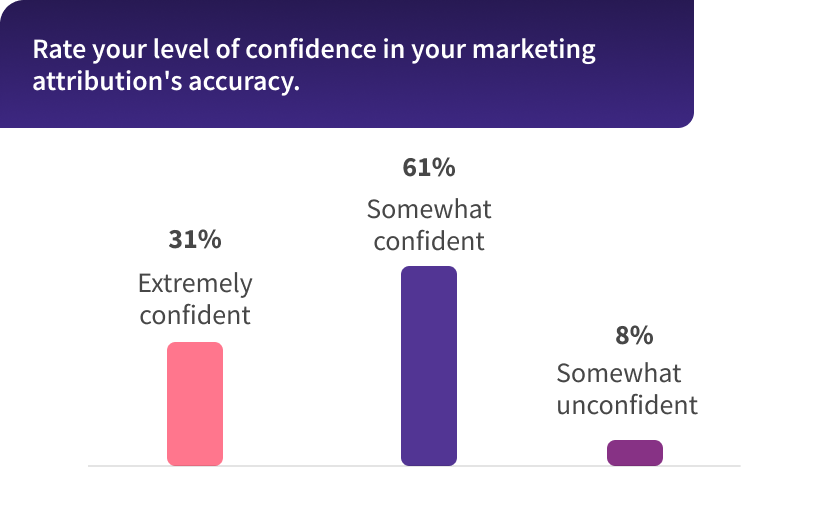
As you can see, our survey data reveals that while the majority of respondents have a reasonable level of confidence in their attribution accuracy, there is a notable portion that does not feel fully confident, suggesting a need for more robust and reliable attribution methods.
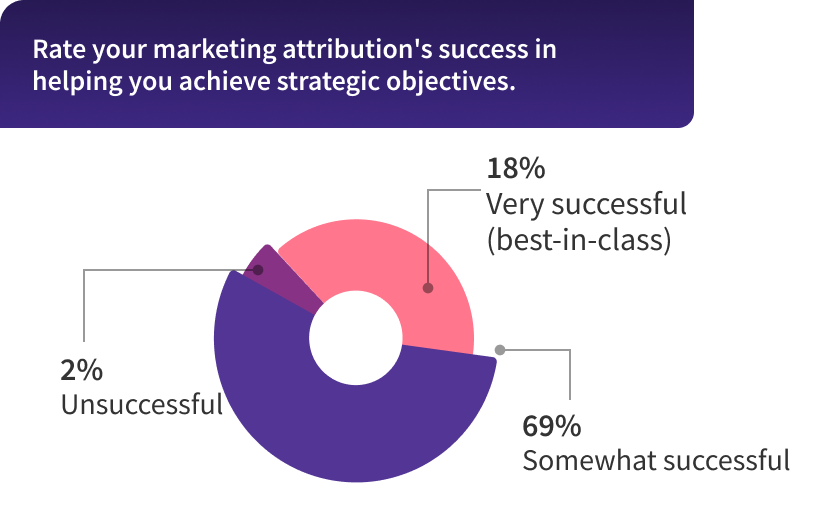
The survey also indicates that while most respondents find some success in their marketing attribution, achieving a higher level of efficacy and best-in-class results remains a goal for many. This aligns with the need for more advanced and reliable attribution methodologies to better support strategic objectives.
1
Methodology Limitations of Traditional Attribution
The limitations of traditional attribution are rooted in both methodological and applicability constraints.
These limitations significantly hinder the ability of marketing teams to capture and analyze the full scope of their efforts effectively. Here are the key methodological limitations:
  • Incomplete Data Capture: Traditional attribution models often fail to capture the complete set of data required to understand the full buyer journey. This incomplete data set leaves gaps in the analysis, leading to less reliable insights.
  • Limited to Marketing Campaigns: These models typically focus solely on marketing campaigns, ignoring the critical synergies that occur across Marketing, SDR/BDR, and AE campaigns. This narrow focus prevents a comprehensive view of how different teams and efforts contribute to conversions.
  • Does Not Capture Synergies Across Teams: The inability to capture synergies across Marketing, SDR/BDR, and AE campaigns means that traditional models cannot accurately attribute the collective impact of these integrated efforts. This leads to underestimating the true value of collaborative campaigns.
  • Cannot Adapt to Hybrid GTM Motions: Traditional attribution models struggle to adapt to the increasingly complex hybrid go-to-market (GTM) motions that combine various sales and marketing tactics. This inflexibility limits their effectiveness in modern, dynamic marketing environments.
  • Rules-based Attribution Methods: These methods do not effectively capture the complex online and offline buyer journeys. Rules-based approaches can be overly simplistic, failing to account for the nuanced and multifaceted interactions that influence buyer decisions.
Addressing these methodological limitations is essential for developing a more robust and accurate attribution framework that can provide actionable insights and drive better marketing and sales alignment.
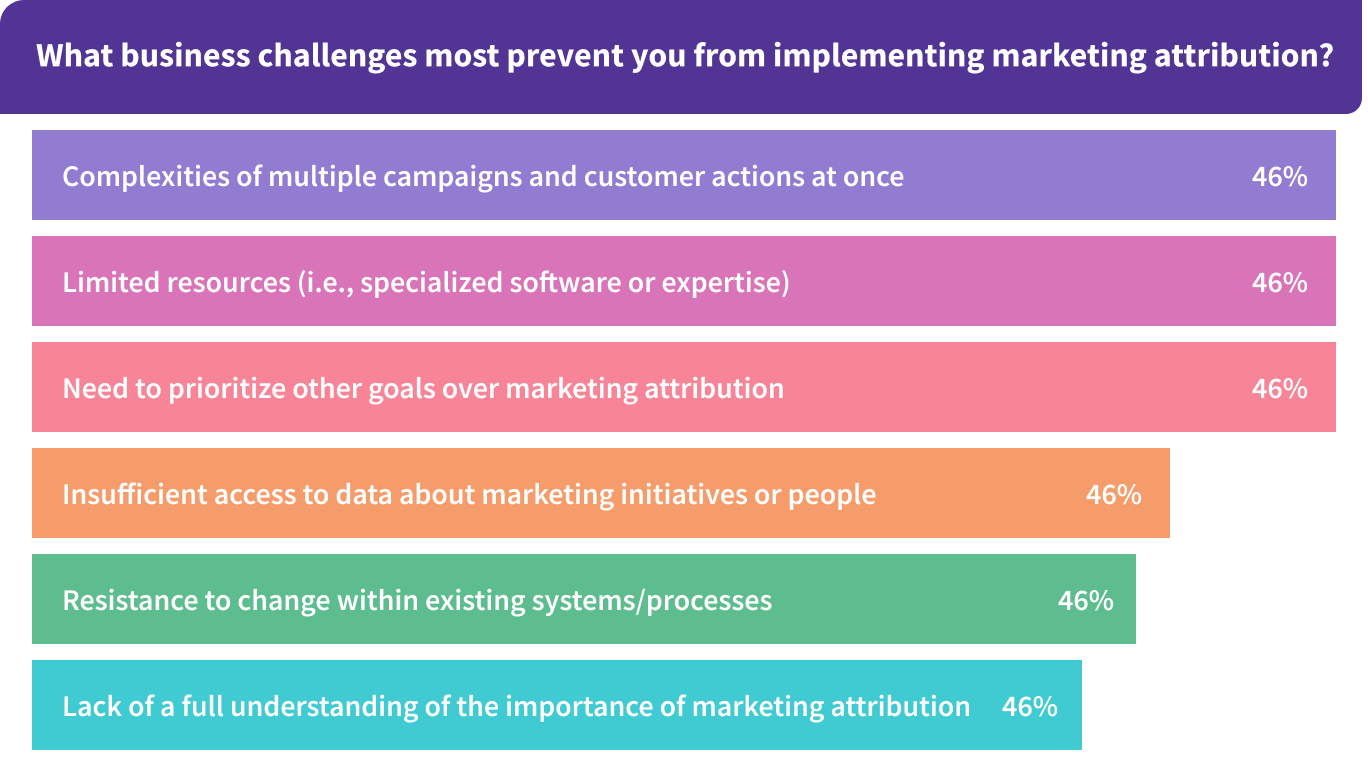
As you can see in the chart above, technical complexities and organizational barriers play significant roles in preventing the effective implementation of marketing attribution. Addressing these challenges requires not only the right tools and expertise but also a cultural shift toward prioritizing and understanding the value of attribution.
2
Applicability Limitations of Traditional Attribution
In addition to methodological limitations, traditional attribution models face several significant applicability constraints that further hinder their effectiveness. These limitations include:
  • After-the-Fact ROI Reporting: Traditional attribution often involves retrospective analysis, which limits the
ability to drive early changes or reallocate resources effectively. By the time insights are gathered, it may be too late to pivot strategies and optimize outcomes.
  • Disconnected from Day-to-Day Funnel Management: Traditional models are frequently isolated from the
daily operations of funnel management. This disconnection means that the insights they provide are not easily integrated into the ongoing management and optimization of marketing and sales activities.
  • Limited Insights Across Segments, Personas, and Regions: These models often fail to provide detailed
insights that span different customer segments, personas, and geographical regions. This lack of granularity restricts the ability to tailor marketing strategies to specific target audiences.
  • Unable to Account for Dark Funnel Contributions: Traditional attribution methods struggle to account for the contributions of the "dark funnel"-the unseen and often indirect interactions that influence buyer behavior. This gap leaves a significant portion of the buyer journey unquantified and unacknowledged.
  • Unable to Quantify Contribution of Campaigns to Driving Velocities and Conversions: These models lack the ability to accurately measure how individual campaigns contribute to the acceleration of conversions and the overall velocity of leads through the funnel. This limitation makes it difficult to understand which campaigns are truly effective in driving business results.
Addressing these applicability limitations is crucial for developing an attribution framework that provides comprehensive, actionable insights and supports the continuous optimization of marketing and sales strategies.
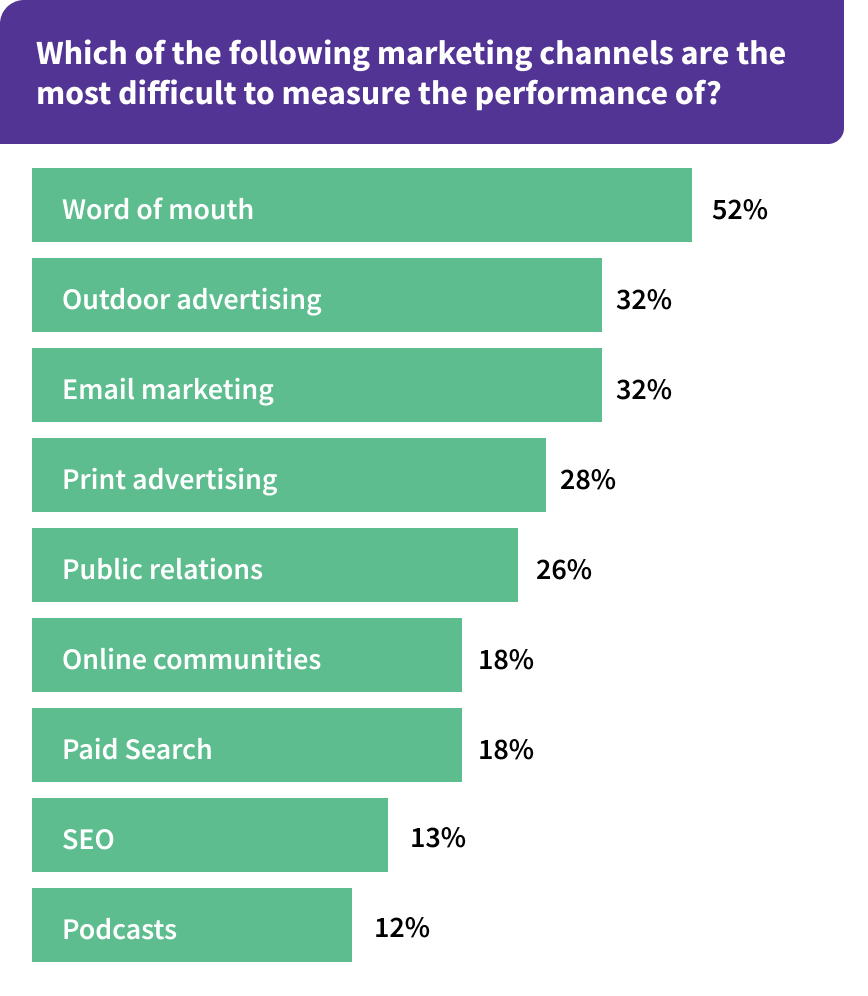
Our survey reveals that the most difficult marketing channels to measure are word of mouth, outdoor advertising, and email marketing. Print advertising and PR also pose significant challenges.
These findings highlight the complexity of tracking and quantifying the impact of various marketing efforts, especially those that are less direct or harder to monitor, underscoring the need for advanced attribution methods to enhance measurement accuracy across all channels.

Recent Advances in Attribution: Progress, But Not Enough

Recent advancements in attribution methodologies have certainly provided improvements, but they are not sufficient to address all the challenges faced by modern B2B marketing teams. These advancements include:

Multi-touch Attribution

Models such as U-shaped and W-shaped attribution have helped provide a more nuanced understanding of the buyer journey by recognizing multiple touchpoints that contribute to conversions. However, while these models offer a more detailed perspective than single-touch attribution, they still fall short of capturing the full complexity of the buyer journey.

Measurement to Pipeline and Closed Won

Moving beyond just measuring leads and Marketing Qualified Leads (MQLs), modern attribution now extends to measuring contributions to the pipeline and closed-won deals. This approach provides a clearer link between marketing efforts and actual sales outcomes, enhancing the accountability of marketing activities. Despite this, there are still gaps in connecting these measurements to actionable insights that can drive continuous improvement.

Granularity Around Content/Assets

Recent methods have introduced greater granularity in measuring the impact of specific content and assets. This granularity helps in understanding which pieces of content or assets are driving engagement and conversions. However, while this detailed analysis is valuable, it is not always integrated effectively into a holistic attribution model that considers the entire funnel and all touchpoints.
Despite these advancements, significant gaps remain in providing comprehensive, actionable insights that can drive strategic decision-making and optimization across marketing and sales activities. A more integrated and advanced approach is needed to truly transform attribution from mere measurement to actionability.

What We Are Hearing From The Market

Despite recent advancements, marketing stakeholders continue to face significant challenges with traditional attribution methods.
Feedback from industry leaders highlights these ongoing issues.
These challenges reflect a broader need for a more advanced, actionable approach to attribution that can address these detailed requirements and provide marketing teams with the insights necessary to optimize their strategies effectively.
Head of Demand Gen, Data Security SaaS
I need to easily understand the cross-funnel conversion and impact of not just campaigns, but Ad groups and Ads too. This is a big ask from my CMO.

This feedback underscores the need for a more comprehensive view of cross-funnel conversions, including detailed insights into how various campaigns, ad groups, and individual ads contribute to conversions.

Director of Digital Marketing, Information Technology SaaS
What are the most effective touch/campaign sequences Lead -> MQL conversion vs. MQL -> SAL? Our attribution does not give us that insight. It is limited to revenue and pipeline reporting.

This comment points to the necessity for attribution models that can provide detailed insights into the sequences of touches and campaigns that are most effective at different stages of the funnel, from leads to MQLs to Sales Accepted Leads (SALs).

VP Marketing, Spend Management SaaS
Most attribution solutions have the problem of death by combinations. What I'm looking for is something that helps me make decisions quickly on what's working and what's not.

This feedback underscores the need for a more comprehensivHere, the need for simplified, actionable insights is clear. Marketing leaders are looking for solutions that avoid overwhelming complexity and enable quick decision-making.e view of cross-funnel conversions, including detailed insights into how various campaigns, ad groups, and individual ads contribute to conversions.

VP Demand Generation, Digital Whiteboard SaaS
We are trying to figure out the right nurturing tactics for leads based on what we have seen work earlier, e.g., before conversion are they scheduling a meeting, raising their hand, are they signing up for a trial, etc.

This comment emphasizes the need for attribution models that can provide insights into effective nurturing tactics, helping teams understand which actions and engagements are most likely to lead to conversions.

Head of Demand Generation
We are struggling with accurate attribution of qualified leads and opportunities, from what marketing initiatives, accurate prospect journeys, and most impactful touches for conversion.

This feedback highlights the difficulty in accurately attributing qualified leads and opportunities to specific marketing initiatives, as well as understanding the most impactful touches along the prospect journey.

What If There Was a Better Approach: Transitioning from Measurement to Actionability

To overcome the limitations of traditional attribution methods and provide actionable insights, it is essential to consider six key dimensions while applying attribution. These 6 dimensions help you define your overall framework and approach to attribution across your team, function, and company.
Scope and data refer to what data and what activities you want to include in your attribution efforts.
What activities/segments/touches/campaigns will
maximize pipeline & revenue performance for
upcoming weeks/months
Analytical approach refers to a combination of the measurement methodology used whether that is a touch-based attribution method (single touch, multi-touch) or a marketing mix approach combined with the algorithmic approach (rules-based, probabilistic, multivariate time series regression, or incremental testing approaches).
The results provided refer to your expectations of the outputs and outcomes of the attribution.
Timeliness refers to the time frame in which you want the outputs to help you make better decisions. Is it daily/monthly/quarterly?
Actionability refers to the kind of actions you expect attribution insights will help you make.

Scope: From Marketing Campaigns to E-2-E GTM Motion

Old Game

Attribution focused solely on marketing campaigns, channels, and touches, limiting the perspective to isolated activities.

New Game

A comprehensive approach that includes the full funnel-campaigns and activities across Marketing, SDR/BDR, and Sales motions. This holistic view ensures that all interactions are accounted for, providing a more accurate picture of their collective impact.

Focus/Key Question: From Credits to What to Double Down on

Old Game

The primary question was "Who should get the credit?" This often led to disputes and a narrow focus on attribution.

New Game

Shifts to "What activities/touches/campaigns/channels will maximize performance for upcoming weeks/months?" This involves understanding the role of each tactic at different stages of the buyer journey and identifying strategies that drive pipeline and revenue performance.

Analytical Approach: From Rules-based Attribution to Al-based MTA

Old Game

Using rules-based attribution methodology (like single touch or multi-touch like U-shaped, W-shaped, or opinion-based weighting for each touch). Marketing mix and incremental testing approaches are seldom used.

New Game

Focuses on using a hybrid of probabilistic multi-touch based attribution, multivariate and time series regressions-based marketing mix, and incremental testing approaches to derive the maximum insights.

Results: From ROI Measurement to Recommendations

Old Game

Emphasis was on the reactive measurement of ROI and contribution in the past quarters and months, often resulting in backward-looking insights.

New Game

Focuses on actionable insights determining what to double down on, where to allocate marketing spend, and which tactics to deploy to accelerate conversions and velocities. This proactive approach helps in continuously optimizing marketing efforts.

Timeliness: From Backward Looking to Forward Looking

Old Game

Insights were often provided quarterly, with a backward-looking perspective that waited until the end of the quarter or campaign to analyze performance.

New Game

Emphasizes pivoting early. Near real-time tracking and attribution with forward-looking performance predictions enable timely adjustments. This ensures that strategies remain aligned with current performance data and can be optimized continuously.

Actionability: From Planning to Real-time Refinement

Old Game

Reporting was focused on campaign effectiveness with some insights for planning, often leading to limited actionable outcomes.

New Game

Provides actionable insights on the "Next Best Touch/Campaign" to drive speed to pipeline and revenue. This includes enabling investment and decisions from channel to tactic, and ensuring that marketing efforts are always strategically aligned and effective.

By adopting this new approach, attribution moves beyond just measurement and becomes a vital tool for driving strategic decisions and optimizing marketing and sales performance. This transition ensures that teams can act on insights promptly, leading to improved outcomes and sustained growth.

What If There Was a Better Way?

From
To
Marketing Campaigns
E-2-E GTM Motion
Credits?
What to Double Down On?
Rules-based Attribution
Hybrid of Al-based MTA, MMX and Incrementality Testing
ROI Measurement
Recommendations on Reallocation/Refinement
Rear-view/ Backward-looking
Windshield/Forward-looking
Planning
Real-time Refinement/ Next Best Touch

Defining & Implementing the Future of Attribution

Now we will walk through each of the dimensions necessary for transitioning attribution from measurement to actionability. The first dimension is Scope.
1
Scope: From Marketing Campaigns to E-2-E GTM Motion
Old Game
  • Marketing Campaigns Only:
    Traditional attribution focuses solely on marketing campaigns, isolating them from other critical activities..
  • Closed Pipeline/Revenue Sourced or Influenced by Marketing:
    Attribution is limited to assessing the revenue directly. sourced or influenced by marketing efforts, ignoring the broader funnel dynamics.
New Game
  • Full Funnel: The new approach encompasses campaigns and activities across Marketing, SDR/BDR, and Sales motions. This holistic view ensures that all relevant interactions are considered.
  • Accelerate Stage-to-Stage Conversions: Focus on touches and campaigns that drive stage-to-stage conversions along the entire buyer journey, from anonymous visitors to closed-won business. This perspective helps in understanding how different activities contribute to moving prospects through the funnel.
  • Assess the Role of Each Campaign/Touch: Evaluating the specific role and impact of each campaign and touchpoint is crucial. This includes identifying which interactions are most effective at different stages and optimizing accordingly.

By expanding the scope to include the full funnel and all related activities, the new approach provides a more comprehensive understanding of the buyer journey and how various efforts contribute to conversions and revenue. This broader perspective enables more effective optimization and strategic decision-making.
How to Implement Full Funnel

Integrate Across the GTM Funnel

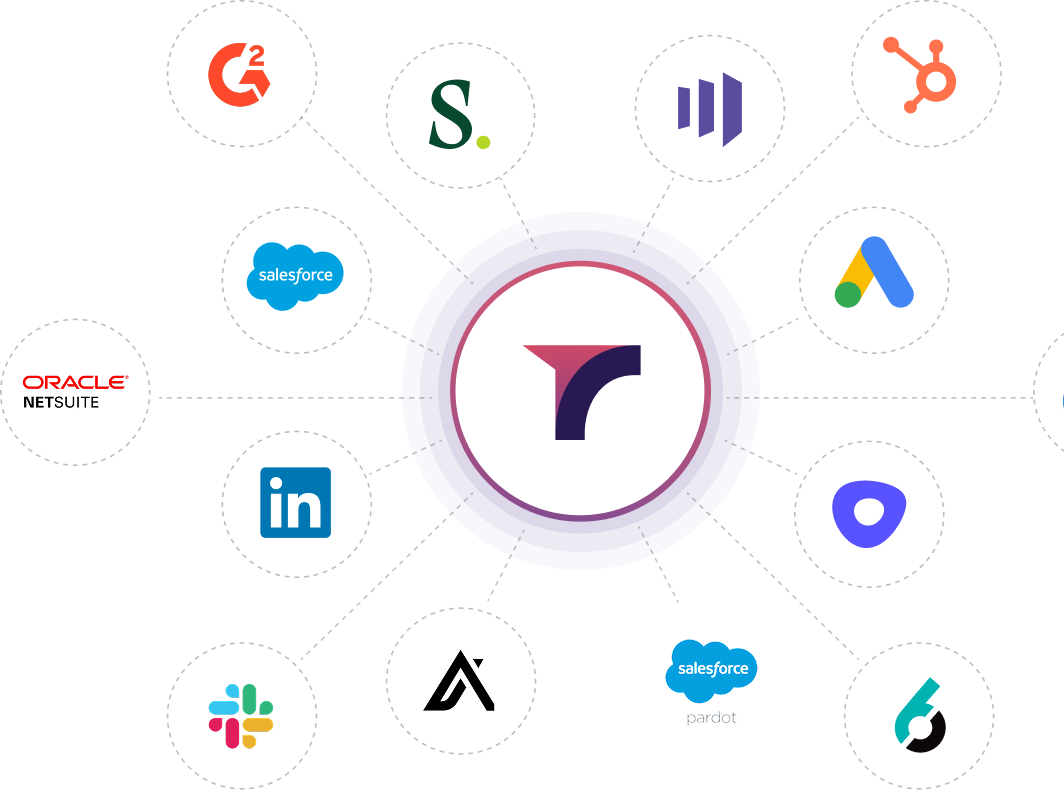
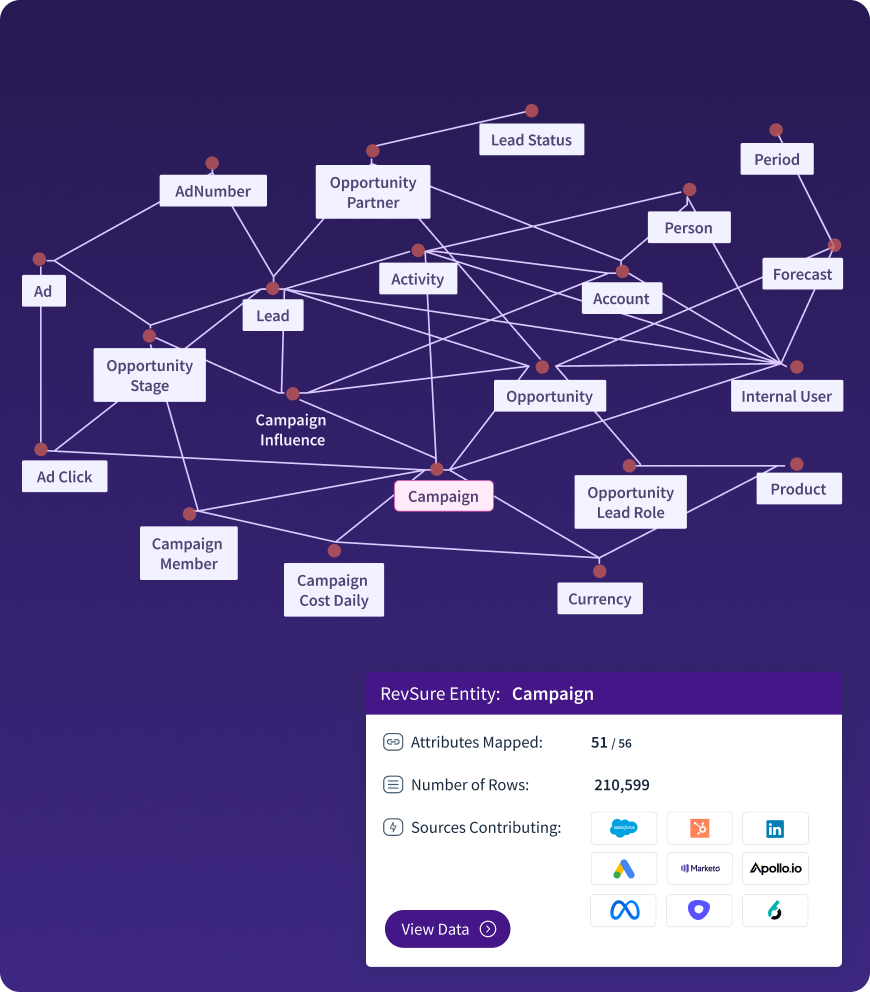
To achieve a holistic and actionable attribution model, it is crucial to integrate data across the entire Go-to-Market (GTM) funnel, capturing all relevant touchpoints and interactions. This integration encompasses various tools and platforms that contribute to different stages of the buyer journey:

Unified GTM Data Graph

A unified GTM data model integrates and harmonizes data from these multiple systems, creating a comprehensive view of the buyer journey from the initial visit to customer renewal and expansion. This interconnected data graph allows for stitching and mapping end-to-end journeys, ensuring every activity, touch, campaign, visit, impression, and click is captured and analyzed.

By integrating all touchpoints across the GTM funnel, organizations can gain a complete and actionable understanding of the buyer journey, enabling more effective attribution and strategic decision-making. This holistic approach ensures that all interactions are accounted for, providing a robust foundation for optimizing marketing and sales efforts.
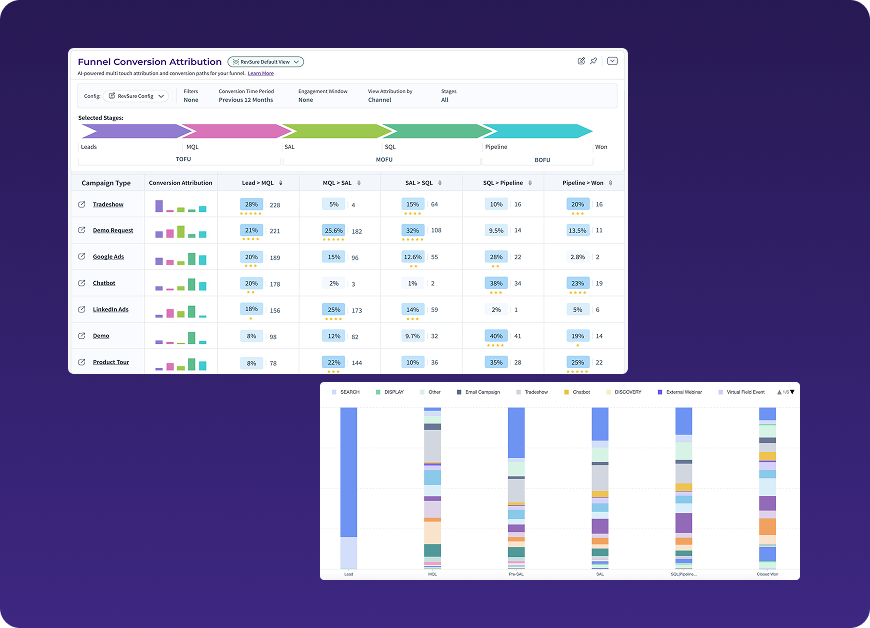
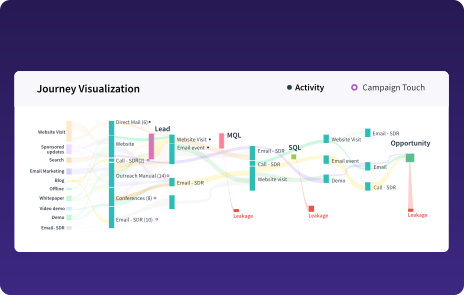
Stitch, Map, & Visualise the End-to-End Journeys at Granular and Aggregate Levels

Integrating data across the entire GTM funnel enables the ability to stitch and map end-to-end buyer journeys comprehensively. This approach provides a detailed view of how prospects interact with various touchpoints over time, leading to more accurate and actionable insights. Key elements include:

Stitch Journeys at Lead/Account/Opportunity Level:

By connecting data points from different stages of the buyer journey, we can create a cohesive narrative for each lead, account, or opportunity. This stitching process involves linking various interactions and engagements to form a complete picture of the buyer's path.

Capture All Activities /Touches /Campaigns /Visits /Impressions /Clicks

A comprehensive attribution model must capture every interaction, not just the major touchpoints. This includes website visits, form fills, newsletter interactions, reports, webinars, blogs, sales inquiries, trade shows, e-books, live demos, and more. Each of these activities contributes to the buyer's journey and must be accounted for to understand their impact fully.

Not Limited to "Clicks":

Traditional attribution models often focus heavily on clicks,
which can provide an incomplete picture. The new approach expands beyond clicks to include all forms of engagement, ensuring that no critical touchpoints are overlooked.

The journey timeline visualization provides a clear and detailed view of a prospect's interactions over time. This timeline shows the sequence of activities, campaign touches, and engagements, allowing for an in-depth analysis of how each interaction contributes to the overall journey.

  • By capturing and mapping these details, marketing teams can identify the most effective touchpoints and optimize their strategies accordingly.
  • By discovering the top buyer journeys, marketing teams can optimize their efforts to focus on the most effective touchpoints and strategies.
This detailed understanding of the buyer journey from anonymous visitor to conversion allows for continuous improvement and more precise targeting, ultimately leading to higher conversion rates and better ROI.

Use Al to Elicit the Top Touches in the Path to Conversion

Advanced attribution involves using Al to discover the top touches in the path to conversion at every stage. This process helps in identifying the most effective interactions that drive prospects from initial engagement to closed-won deals.

Key Benefits of Al-driven Touch Analysis
  • Separate the Signal from the Noise: Al helps to distinguish the most impactful touches from less significant interactions. This clarity enables marketing teams to focus on what truly drives conversions.
  • Identify the Most Effective Touches and Paths: By analyzing the entire buyer journey, Al can pinpoint the specific touches and sequences that lead to successful conversions. This insight is crucial for optimizing marketing strategies and ensuring that resources are allocated to the most effective activities.
  • Probabilistic Al Models: Unlike traditional opinion or rules-based approaches, probabilistic Al models can provide more accurate weightings for different touchpoints. These models use data-driven methods to determine the relative importance of each interaction, leading to better-informed decisions.

Quantifying the Incremental Contribution at Every Stage of the Funnel

To optimize marketing strategies effectively, it's essential to quantify the incremental contribution of each touchpoint at every stage of the funnel. This approach provides detailed insights into how specific interactions drive conversions at different stages, allowing for more precise and impactful marketing efforts.

Key Benefits
  • Understand the Role of Every Campaign: By analyzing the role of each campaign and campaign type at various stages of the funnel, marketers can identify which activities are most effective in progressing leads from one stage to the next. This understanding helps in tailoring strategies to leverage the most impactful touchpoints.
  • Deploy Campaigns Effectively: With a clear view of how
different campaigns contribute to conversions at each stage, marketing teams can deploy campaigns more effectively. This means focusing resources on the activities that are proven to drive results, leading to better ROI and more successful marketing efforts.
2
Focus/Key Question: From the counter-productive "Who Gets the Credit" question to "What campaigns and channels will maximize pipeline and revenue"?
Old Game

Who/What Touch Should Get Credit?: Traditional attribution often revolves. around assigning credit to specific touches or activities. However, this question alone can lead to limited insights and internal disputes over credit allocation.

New Game
  • What campaigns and activities will maximize Pipeline & Revenue Performance for Upcoming Quarters?: Instead of merely asking who should get credit, the focus should be on understanding which activities, touches, campaigns, and channels will drive the best performance in upcoming quarters. This proactive, forward-looking approach aims to optimize future outcomes rather than just analyzing past performances.
  • Full Funnel Impact of Campaigns: It's critical to evaluate the full funnel impact of campaigns, not just individual touchpoints. This comprehensive analysis includes understanding how each campaign influences different stages of the funnel, from initial engagement to final conversion. By considering the entire funnel, marketers can develop more holistic and effective strategies.

How to Implement

Embrace & Integrate Predictive Analytics

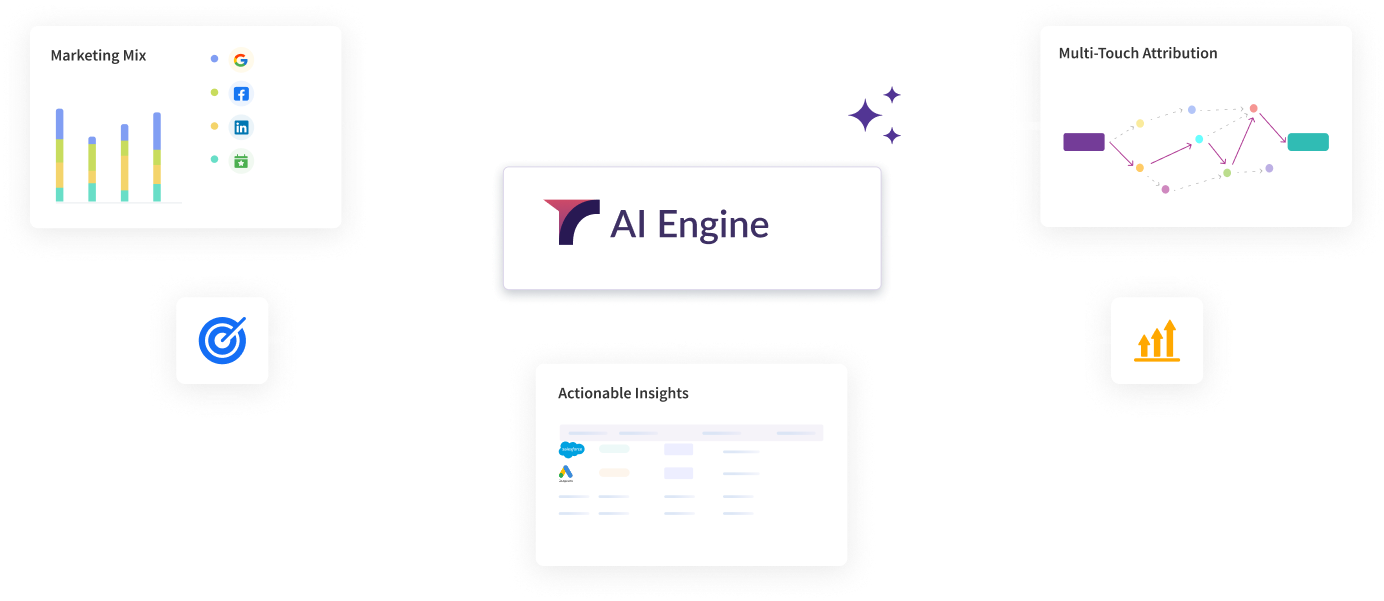
Utilizing predictive Al approaches that combine multivariate time-series regressions with touch-based probabilistic attribution can significantly enhance the accuracy and actionability of attribution insights. These advanced models help in identifying the true drivers of conversions and predicting the impact of different activities on future performance.

Regular Monitoring and Adjustments

Continuously monitor the projected performance of campaigns and adjust strategies as needed. This dynamic approach ensures that marketing efforts are always optimized for the best possible outcomes.

3
Analytical Approach: From Rules-based Attribution to Al-driven Multi-touch, Marketing Mix, and Incrementality Testing
Old Game
  • Traditional attribution methods such as first touch, last touch, source-based attribution, or a customer rule that looks at opinion-based weightings (e.g. if a lead came in through marketing but did not convert into a meeting in 90 days do not give credit to marketing).
  • These approaches lead to credit and attribution wars.
  • The focus is only on backward measurement and reporting.
New Game
  • Uses Data and Al to learn and predict the performance of campaigns, channels, content, ads, and creatives as well as efforts across the Full Funnel (Marketing, SDR/BDR, Sales, Partnerships, Communities).
  • Focus on forward-looking recommendations and decisions.
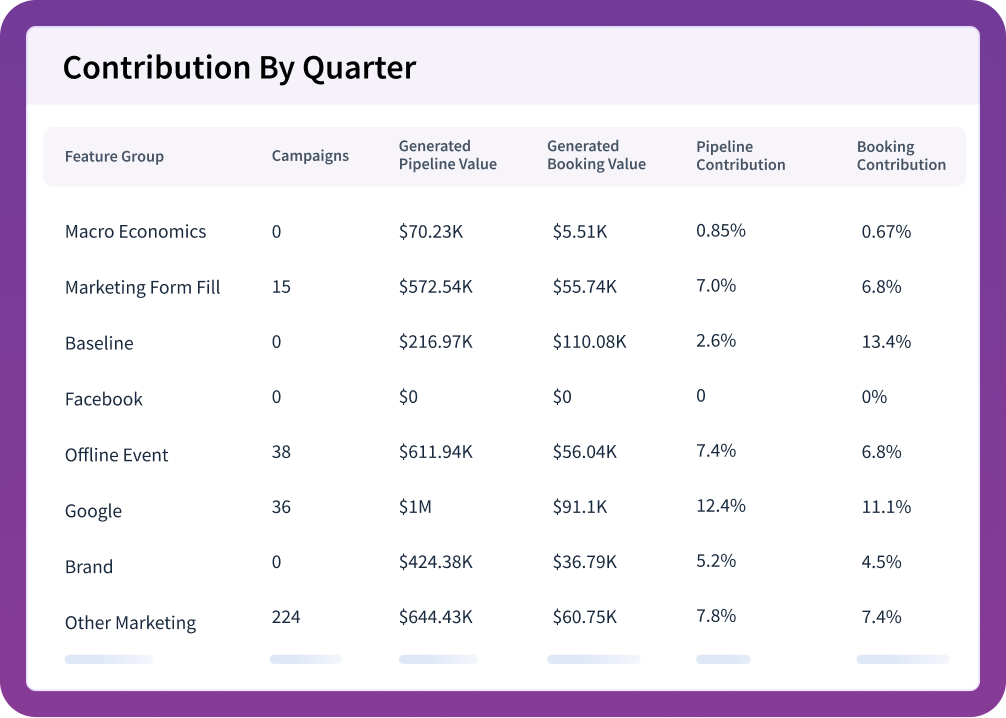
  • Applies a hybrid of probabilistic multi-touch-based attribution that discovers the relative weightings and impact of each touch based on the data, and multivariate time series regression-based approaches for marketing mix analysis. The combination of multi-touch and marketing mix enables the ability to drive insights at the strategic, tactical, and operational levels.
  • Brings the impact of external factors such as macro-economics and competitive efforts.
  • Uses incremental testing for scenarios where data might not be available and experiments need to be run to gather data and measure the statistical significance of marketing efforts such as new event types, campaigns, activities, creative variations, and new channels.

Avoid the recent ideological debates between Marketing Mix and Multi-touch Attribution

In the realm of marketing analytics, the debate often centers around Marketing Mix (MMX) versus Touch-based Attribution.

MMX advocates highlight the limitations of touch-based attribution, emphasizing its dependence on capturing touches and clicks, being limited by privacy regulations, and insufficient quality data in the CRM and other source systems.

On the flip side, attribution proponents view MMX as mathematical calculations without traceability to tangible outcomes at the campaign, account, lead, and opportunity levels, as well as needing consistent month-on-month and week-on-week spending data that is not usually captured consistently for channels such as webinars, virtual events, content assets, and SEO efforts.

The fact is both Marketing Mix and Multi-touch Attribution are just analytical frameworks with pros and cons.

In this ongoing discourse, the crucial factor often overlooked is the level of decision-making and insight sought. What if we told you it's not an either-or scenario, but rather a powerful combination of both that unlocks a new level of strategic insight and tactical execution?

Strategic Planning with Marketing Mix

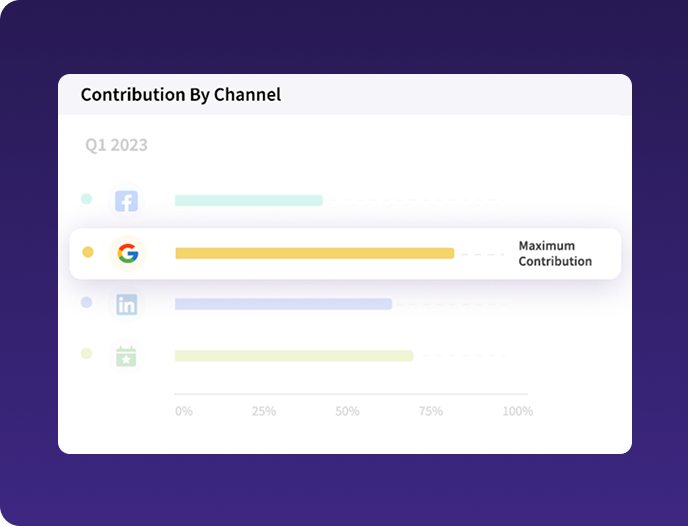
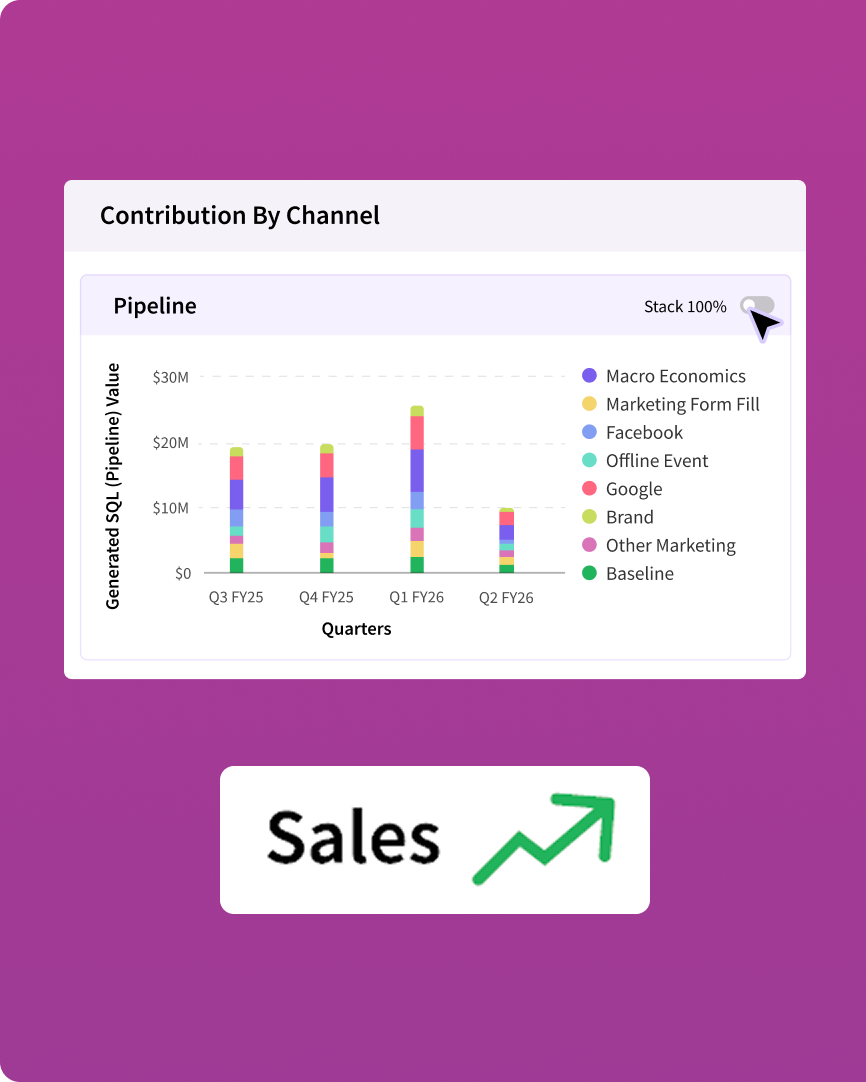
Consider Marketing Mix as your strategic compass. It proves invaluable when making channel-level decisions for the upcoming months and quarters. Whether it's Google, Linkedin, Meta, or Conferences, MMX helps answer pivotal questions: How should spending be allocated across channels to maximize ROI and pipeline?

It excels at guiding planning, budgeting, and allocation decisions. However, when it comes to evaluating the effectiveness of specific campaign tactics and creatives or understanding the sequence of touches needed for funnel movements and conversions, MMX falls short.

Tactical Execution with Multi-touch Attribution

This is where Al-based Multi-Touch Attribution (MTA) steps in, driven by data and Al, not rigid rules. MTA facilitates daily and weekly decisions for tactical execution, re-allocation, and day-to-day funnel management. The ability to capture impressions from digital channels, track anonymous visits, and follow the visitor's journey to conversion through the deep funnel has significantly enhanced the utility of attribution methods.

The once elusive dark funnel is now illuminated, thanks to evolving methods in attribution.

Finding Harmony in Dual Methodologies of Marketing Mix and Multi-Touch Attribution

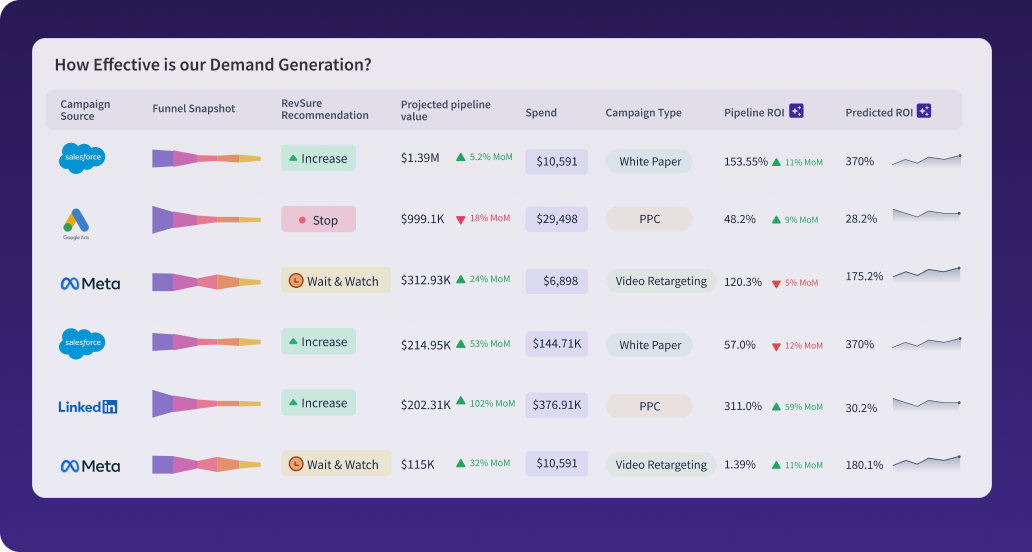
The key for marketers is understanding how to leverage the strengths of both MMX and Attribution. Use the marketing mix approach for strategic budgeting and allocation decisions. Simultaneously, employ attribution for agile tactical execution, providing real-time insights into when to stop, increase, or decrease spending on specific campaigns and tactics.

In Enterprise B2B and B2C spaces, the marriage of Marketing Mix and Attribution is not just a harmonious coexistence; it's a strategic imperative. Each methodology finds its place, contributing to a holistic marketing strategy that balances long-term goals with agile, day-to-day decision-making.

Experimentation and Incrementality Testing

While marketing mix and multi-touch attribution are very useful in cases where historical data is available there are many situations where data is not available or the data available is not sufficient to be included in either analytical approach to answer the business question. E.g. running a new ad creative, using a new message, expanding into new channels, and assessing the impact of one-time events.

In such cases, marketing teams need to be able to either run experiments or partition their existing data into test and control groups and measure the difference in effectiveness and response.

This is where A/B and incremental testing approaches are very useful.

The key here is to be able to either conduct controlled experiments or effectively isolate test and control groups in a way you can measure the impact of the activity (creative, new campaign, message) on the response.

4
Measurement Timelines: From Quarterly Rear-View to Real-time Wind-shield Navigation
Old Game
  • Quarterly, Backward-Looking: The traditional model involves waiting until the end of each quarter or campaign to analyze performance. This approach often delays insights and decision-making, preventing timely optimization.
  • Wait Until End of Quarter/Campaign: Marketing teams typically wait until the end of the reporting period to assess the effectiveness of their efforts. This lag can lead to missed opportunities and delayed response to market changes.
New Game
  • Near-Real-Time Tracking & Attribution: Modern attribution leverages near-real-time data tracking and analysis, providing continuous insights into campaign performance. This real-time approach enables marketing teams to monitor activities and adjust strategies on the fly.
  • Forward-Looking Predictions: By incorporating predictive
analytics, marketing teams can forecast the future impact of current campaigns. This forward-looking perspective helps in making proactive decisions that drive better outcomes.
Benefits of Real-time, Predictive Attribution
  • Timely Adjustments: With real-time tracking, marketing teams can increase, stop, or continue campaigns based on current performance data. This agility ensures that resources are allocated to the most effective activities.
  • Assessment of Momentum: Regular assessment of the momentum, quality of leads/ accounts, and predicted performance allows for a more dynamic and responsive marketing strategy. This continuous evaluation helps in identifying trends and making adjustments before the end of the reporting period.
  • Proactive Decision-making: Predictive analytics provide insights into future performance, enabling marketing teams to anticipate outcomes and make proactive decisions. This forward-thinking approach ensures that strategies are always aligned with business goals and market conditions.
5
Results Provided: From Measurement to Recommendations

Transitioning from traditional measurement of marketing ROI and contribution to a more dynamic, actionable approach is essential for optimizing marketing efforts. This shift allows marketing teams to make data-driven decisions that maximize impact and efficiency.

Old game
  • Measurement of Marketing ROI and Contribution: The traditional approach focuses primarily on measuring the return on investment and contribution of marketing efforts. While this provides valuable insights, it often falls short in guiding future actions and strategy adjustments.
New Game
  • What to Double Down On?: By leveraging advanced analytics, marketing teams can identify the most effective campaigns and activities to invest more resources into. This ensures that high-performing initiatives receive the attention and budget needed to maximize their impact.
  • Where to Put the Next Marketing $?: Instead of relying on intuition, data-driven insights guide the allocation of marketing budgets. This ensures that every dollar is spent in the most effective way possible, enhancing overall campaign performance.
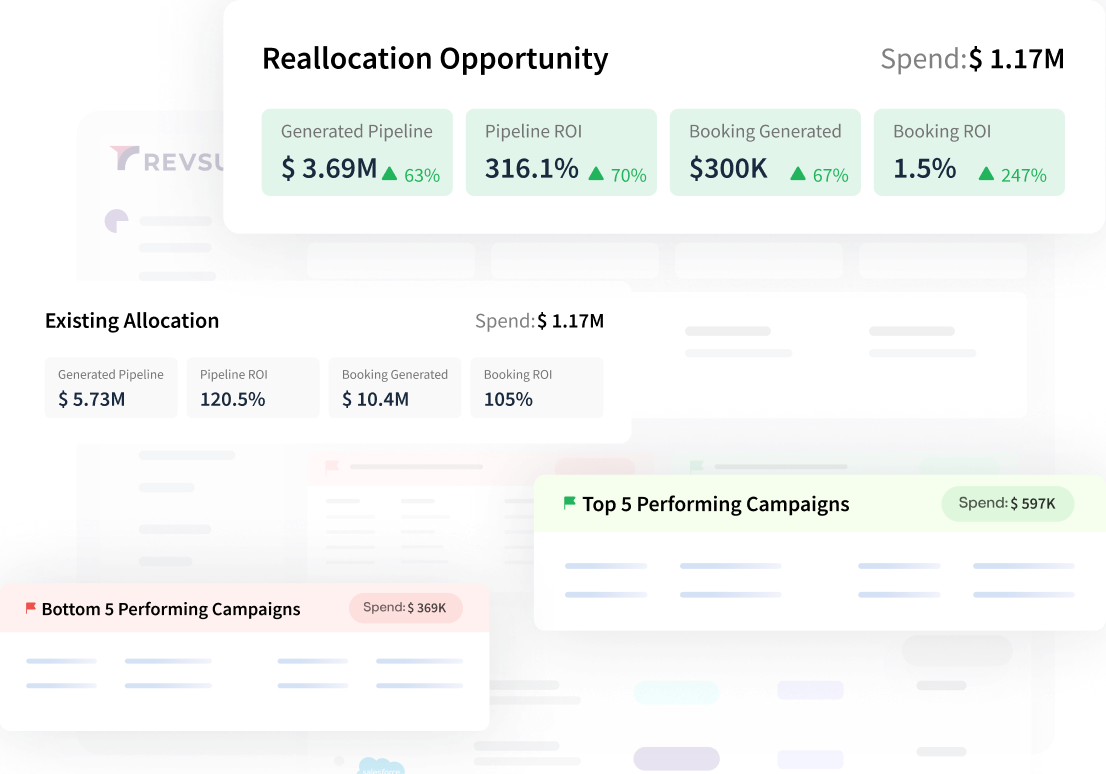
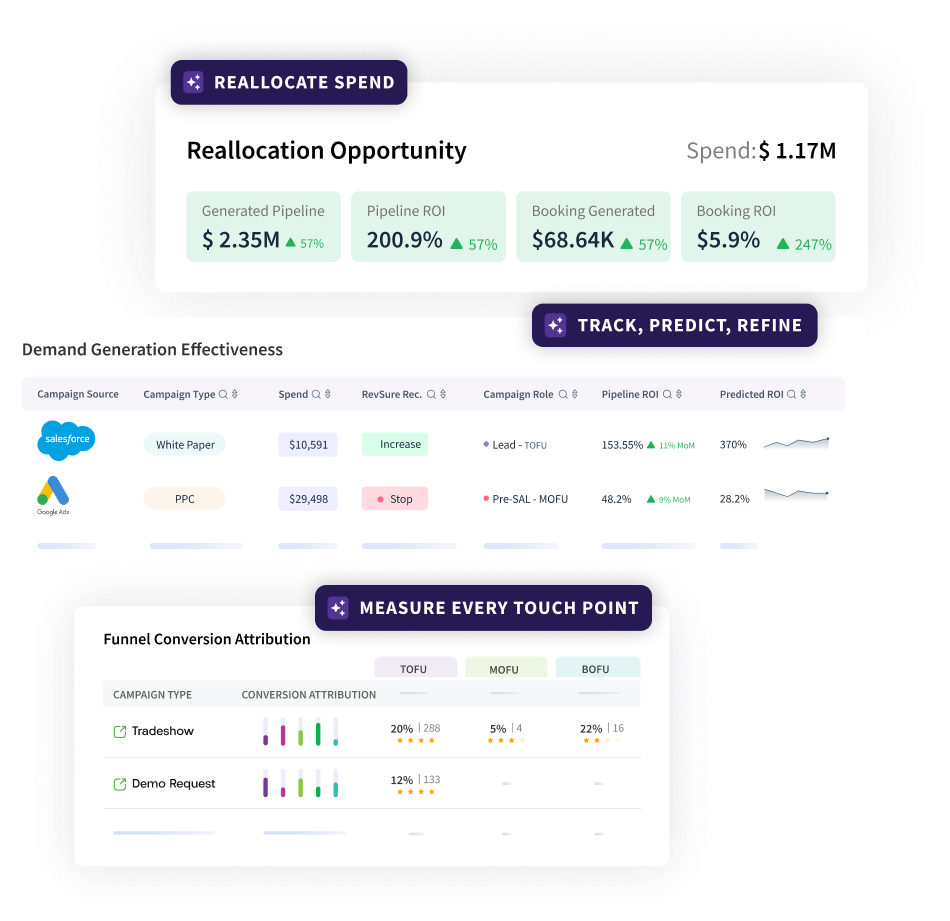
  • How to Reallocate Spend?: Predictive analytics and marginal optimization methods help in reallocating budgets to the campaigns and channels that are predicted to perform the best. This. dynamic reallocation ensures that marketing efforts are continuously optimized for maximum ROI.

How?

Marginal Optimization and Allocation Methods in Data Science: Advanced data science techniques provide a systematic approach to budget allocation. By analyzing various factors and their impact on performance, these methods ensure that resources are allocated in the most effective manner.

6
Actionability from Quarterly Planning Insights to Real-time Refinement and Next Best Touch

To truly drive marketing effectiveness, attribution models must go beyond just reporting and provide actionable insights that can be used to enhance campaign performance and overall strategy.

Old game: Quarterly planning

Currently, the actionability of attribution models is limited:

  • Reporting on Campaign Performance: Attribution models often focus on reporting past performance, which provides some insights but is not sufficient for proactive decision-making.
  • Some Insights for Planning: While useful for planning, these insights are often not timely or prescriptive enough to drive immediate action.
New Game: Real time actionability

To improve actionability, attribution models need to evolve to provide more real-time forward-looking and prescriptive insights:

  • Next Best Touch: Identify the "Next Best Touch" that can drive speed to pipeline and revenue. This involves understanding which campaign or touchpoint should be prioritized next to accelerate conversions.
  • Prescriptive Recommendation Models: Use advanced prescriptive recommendation models to provide actionable insights on campaigns and campaign types. These models help drive conversions and velocities by suggesting specific actions based on data-driven predictions.

By shifting from limited, backward-looking reporting to forward-looking and prescriptive recommendations, marketing teams can make more informed decisions, optimize their campaigns in real-time, and ultimately drive better results.

Conclusion

The future of attribution lies in moving beyond traditional measurement to a more actionable, integrated approach that encompasses the entire GTM funnel. By adopting advanced attribution techniques and leveraging Al-driven insights, marketing leaders can confidently commit to pipeline generation targets, accelerate conversions, and maximize ROI.
Embracing this new model will not only align sales and marketing efforts but also empower teams to make data-driven decisions that drive sustained growth and success.

Decode the Deep Funnel to Prove ROI and Scale Winning Campaigns

Schedule your personal demo to learn how you can gain full-funnel 
attribution insights and improve conversions.