Want to see RevSure in action
Schedule a demo now
Book a Demo


Most GTM teams don’t have a lead problem; they have a prioritization problem.
Your CRM is full. Your marketing channels are “working.” Your reps are busy. But when you look back at the quarter, the same question keeps showing up in every QBR:
Did we work the right leads early enough to change the outcome?
That’s the core promise of propensity scoring: tell me what’s likely to happen next so I can act now. The problem is that most “lead scoring” in the market doesn’t do that. It looks impressive in a dashboard, it produces numbers, and it may even correlate with outcomes… but it isn’t truly predictive.
RevSure’s approach is different. We built propensity scoring as the foundation of our predictive systems because we need it to do something hard: Call the game in the second inning, early in the quarter, when there’s still time to make meaningful changes.
That means our scores can’t be decorative. They have to predict pipeline & revenue.
A lot of scoring systems are basically one of these:
“If Title contains ‘VP’ add 10 points.”
“If company size > 1,000 add 15 points.”
“If a white paper is downloaded, add 20 points.”
Rules can be useful, but they’re not predictive; they’re assumptions.
Some systems “score” based on the stage you’re already in (or recent activity you can already see). That’s not prediction; it’s narration.
It’s tempting to let users “customize” weights, variables, and thresholds. But the more a model becomes a reflection of human intuition, the less predictive it often becomes. Humans are great at storytelling; models are great at learning patterns, especially patterns created by interactions between factors that don’t look important on their own.
This is also why simplistic “top factor” lists can mislead teams. Real conversion outcomes rarely hinge on one magical attribute. They come from combinations: timing + intent + fit + behavior + channel + follow-through, all interacting.
So instead of optimizing for what looks explainable, RevSure optimizes for what’s measurably predictive.
RevSure uses propensity scoring to power two predictive systems:
To make that work, RevSure scores every lead, opportunity, and account. Those individual scores roll up into forecasts, but they’re also useful before the forecast ever matters.
Because once you trust the score, you can use it to orchestrate action across the funnel:
And critically, the scoring improves as the signal improves. The more relevant systems you connect (CRM, marketing automation, website behavior, enrichment, intent, product usage, where applicable), the richer the signal set the model can learn from.
RevSure has a variety of propensity scores, which we abstract into three buckets: Low, Medium, and High.
If you want a model to be predictive, you can’t train it on “today’s” profile and pretend that’s what was true back then. Especially for mid-market and enterprise motions with longer deal cycles and often longer onboarding.
Company size, employee count, tech stack, and even industry classification can change. Training an ML model on updated enrichment data that wasn’t true at the time of conversion creates a quiet but devastating error: you’re teaching the model with the wrong historical reality.
RevSure’s scoring is built to respect point-in-time attributes, what was known at the time, not what a database says now. That’s how you get a model you can trust quarter after quarter.
The simplest test is the one most teams skip:
Score leads at a point in time, then wait and measure what happens later.
In practice, that means running time-shifted backtesting:
This is how you distinguish prediction from narration. And when a scoring system passes this test consistently, it becomes operational. It stops being a report and starts being a lever.
Here are the four facts that matter, not as theory, but as observed performance across real GTM environments.
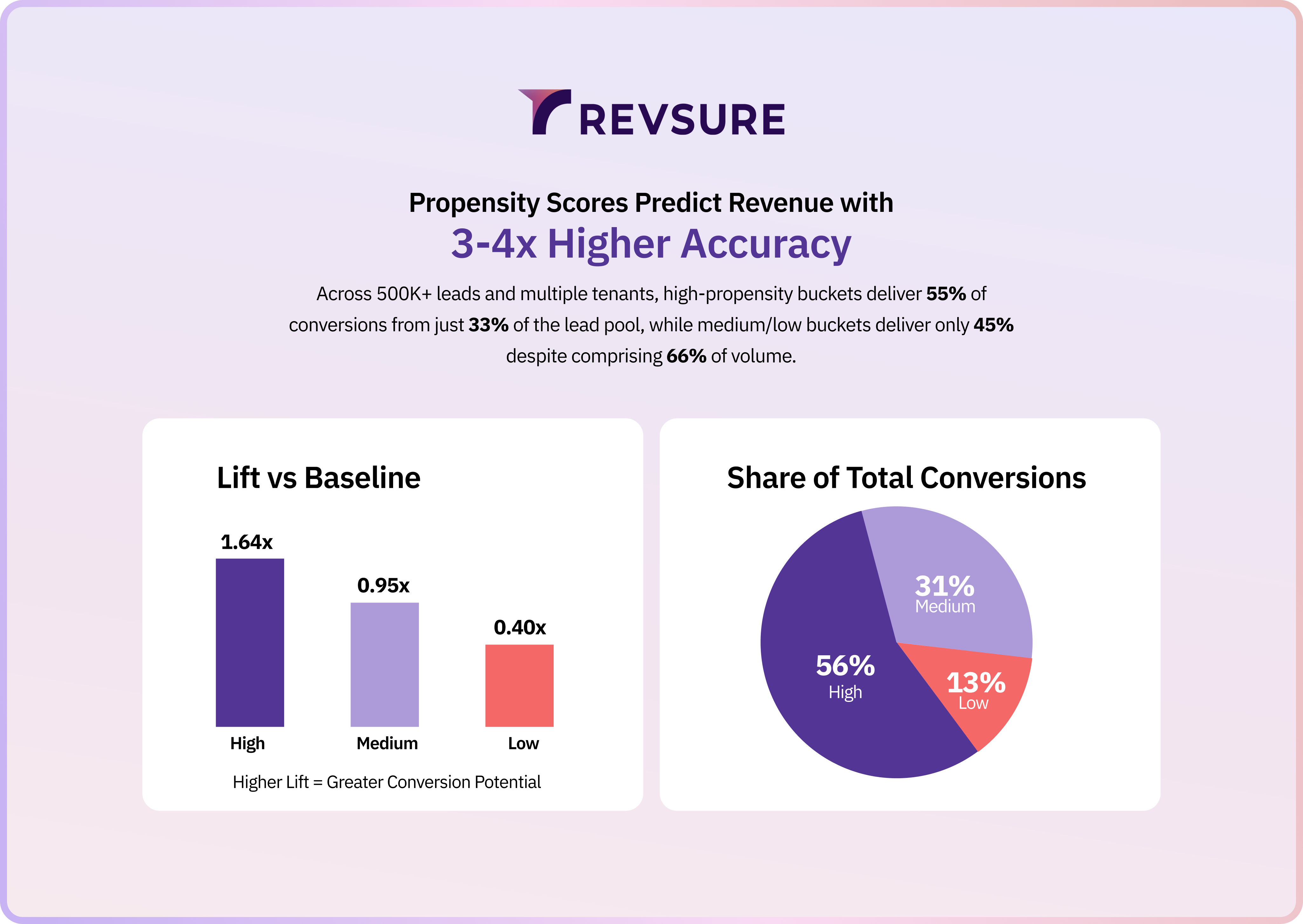
1) High-propensity leads convert 3–8× better than everything else
When RevSure marks a lead as High propensity, it’s not a mild preference. It’s a materially different outcome class. Across funnel stages, High leads convert multiple times better than the rest. That is what makes prioritization possible. Without meaningful separation, scoring is just decoration.
2) Nearly 70% of all won pipeline comes from the High bucket alone
This is the business impact in one line: the High bucket doesn’t just convert better; it drives the majority of revenue outcomes.
And it matches what we see in aggregate conversion behavior, too. In the chart below, you’ll see that High-propensity buckets generate the majority of conversions even though they represent a minority of total lead volume. That “concentration of outcomes” is exactly what scoring is supposed to surface.
3) Our model can call the game in the second inning because it’s predictive, not decorative
If a scoring model only becomes “right” after a lead has already been worked heavily, or after it’s already deep in an opportunity stage, it’s too late. RevSure’s scoring is designed to be directionally correct early, when you can still:
Calling the game early isn’t a slogan. It’s a design constraint.
4) This is proven across millions of leads and multiple tenants, not a toy dataset
Anyone can show a clean uplift curve on a tiny, curated sample. RevSure’s results hold across large volumes and real-world messiness: different industries, different GTM motions, different data quality, different team behaviors, and still the score separates High from the rest in a way that translates into revenue outcomes.
A common misconception about propensity scoring is that it’s only about chasing “high-value leads” and ignoring everything else. That’s not what RevSure is saying, and it’s not how high-performing GTM teams operate.
RevSure’s propensity scoring does reveal something more useful: different buckets deserve different motions. In many GTM motions, the lower buckets are where incremental rep touches have the weakest ROI, not because those leads are worthless, but because expensive human effort is the wrong tool for the job. That’s where automated and AI nurture, retargeting, product-led motions, recycling, or deprioritized routing can do the work efficiently.
The real win isn’t any single conversion rate in Medium or Low. What matters is that the model creates clear separation, so you can concentrate time, budget, and messaging where outcomes cluster, and still run smart, cost-effective plays everywhere else.
Medium and Low aren’t “dead.” They’re the part of your market where marketing optimization can extract value without burning sales capacity, and where a disciplined motion can turn “not now” into “later,” at scale.
When propensity scoring is real, you stop asking “what does this number mean?” and start asking “what should we do because of it?”
Here’s what RevSure customers typically operationalize:
Sales: prioritize execution, not just activity
Marketing: orchestrate message and budget by quality
Deep funnel optimization: close the loop to ad platforms
When you can score quality consistently, you can send those signals back into Google/Meta to improve lead quality, driving:
Forecasting is useful. But control is better.
Propensity scoring is what turns GTM from reactive to proactive, because it tells you, early, where revenue is most likely to come from and what you should do to increase it. If you want to see the charts and the separation in your own data, start with a simple question:
Do our “High” leads actually behave differently months later, or are we just labeling what we already know?
RevSure is built to answer that question and to help you call the game while it still matters.