On this page
Many B2B go-to-market leaders still view pipeline volume as the main indicator of future revenue. Large pipelines feel reassuring because they help hit coverage targets, satisfy the board, and make growth plans look solid. When results fall short, the typical response is to push for more pipeline. But focusing on volume alone can lead to hidden costs. If leaders calculated the cost of each day spent prioritizing volume over readiness, they might see that every stalled week means lost revenue. For example, if a $100,000 deal sits idle for a week, the delay could cost several thousand dollars when you consider opportunity costs and resource use. This urgency shows the risk of relying too much on pipeline size without checking if deals are truly ready.
B2B organizations often miss their forecasts, even when they have three times the needed pipeline volume. Building big pipelines doesn’t always lead to steady results. Teams may still miss revenue goals, deals slow down late in the quarter, and forecasts slip despite good coverage. The problem isn’t a lack of effort or ambition. It’s that pipeline is measured by quantity, not by the chance of deals closing. Pipeline volume shows how much opportunity exists, while pipeline readiness shows if and when those opportunities will turn into revenue. Confusing the two can create a false sense of security and hide risks until it’s too late.
The Limits of Pipeline Volume as a GTM Signal
Pipeline volume became the standard way to predict revenue because it’s simple, familiar, and easy to explain. Coverage ratios offer a quick rule: if you have enough pipeline, revenue should follow. This logic makes sense at a basic level; without enough opportunities, growth is limited. But it’s important to ask: what do we lose by treating every deal the same? Thinking this way can help leaders act sooner instead of just watching from the sidelines.
Take a tech company with impressive pipeline numbers, but they kept missing their quarterly revenue targets. They had too many early-stage deals with little buyer commitment. Instead of driving growth, this overloaded pipeline distracted the sales team from focusing on high-value opportunities and cost them their competitive edge.
The problem is that pipeline volume treats all opportunities as fundamentally equivalent. It assumes that a dollar in the early-stage pipeline carries the same likelihood and timing as a dollar later in the funnel, and that deals progress in predictable ways. In reality, the pipeline is highly uneven. For example, stage-by-stage win-rate variance can highlight this disparity. Deals in advanced stages may have a 70% win rate, while those in the early stages might only convert at 20%, demonstrating the uneven landscape and illustrating that not all dollars are equal.
Opportunities can differ a lot in buyer intent, urgency, team alignment, competition, and risk. Two pipelines with the same dollar value can produce very different revenue results, depending on how deals move through the funnel, or if they move at all. To show these differences, try segmenting opportunities by type: enterprise, mid-market, and SMB. Enterprise deals usually have longer sales cycles and need more team alignment and buyer engagement. Mid-market deals may focus on speed and flexibility, while SMB deals often require quick action and attention to immediate needs. By separating these segments, leaders can adjust their strategies for each group, making pipeline assessments more relevant and effective.
When GTM teams focus mainly on volume, certain patterns show up. Early-stage pipeline fills up with barely qualified opportunities. Deals move forward based on hope, not real buyer signals. Sometimes, deals are pushed ahead just to meet coverage goals, even if commitment is low. These tactics make the pipeline look bigger but actually hurt revenue predictability. To separate hope from commitment, leaders should identify explicit qualification criteria such as the buyer's budget approval status, demonstration of needs alignment through past engagements, and the level of stakeholder involvement. These concrete markers can help leaders more effectively audit their own pipelines and improve the accuracy of revenue forecasts.
Pipeline volume still matters, but it’s not enough on its own. If you don’t know how the pipeline is moving, just looking at size can be misleading. To solve this, we’ll look at a readiness framework that measures conversion potential, speed, and quality. This approach helps make revenue more predictable and improves performance.
Why Big Pipelines Still Miss Revenue Targets
In many established B2B GTM motions, missed quarters are less about an insufficient pipeline and more about a pipeline that lacks measurable momentum and focus. The gap between pipeline and revenue emerges through timing, prioritization, and execution. To address this gap, specific velocity KPIs such as days-in-stage and touches-per-week can be crucial. By highlighting these metrics, organizations can benchmark and track progress in their CRM systems, effectively turning abstract momentum into concrete, actionable insights.
Common patterns tend to repeat:
- Deals sit in stages far longer than planned, compressing close windows
- Opportunities advance without corresponding changes in buyer behavior
- Velocity slows just enough to push revenue beyond the forecast period
From a leadership perspective, these issues are difficult to diagnose early. Standard pipeline reports show totals and stage distributions, but they rarely surface how the pipeline is actually progressing. By the time risk becomes obvious in late-stage numbers, options for intervention are limited. Pipeline readiness exists to make these conditions visible earlier, before revenue outcomes are effectively locked in.
What Pipeline Readiness Measures and Why Leaders Should Care
Pipeline readiness changes how we look at the pipeline. Instead of asking, “Do we have enough pipeline?” it asks, “How likely is our pipeline to convert, and when?”
Readiness is determined by three interconnected dimensions:
- Conversion probability: How deals at each stage actually convert based on historical performance, not static assumptions
- Velocity: Whether opportunities are progressing quickly enough to meet revenue timelines
- Quality: How closely current deals resemble historically successful opportunities in terms of fit, intent, and buyer engagement
Together, these dimensions indicate whether the pipeline represents real, near-term revenue or long-term potential that may never materialize.
For GTM leaders, this distinction matters because it directly affects prioritization. A large pipeline with weak readiness requires different actions than a smaller pipeline with strong momentum. Readiness clarifies where to focus sales effort, where marketing investment is having real impact, and where expectations need to be reset. To bridge this with existing strategies, consider mapping readiness insights to Tier 1-3 accounts. This approach helps guide the intensity of outreach efforts, aligning closely with ABM playbooks. By categorizing accounts by tiers, leaders can better allocate resources and prioritize engagement strategies, ensuring that high-potential accounts receive the necessary attention to maximize conversion opportunities.
Readiness as a More Reliable Indicator of Revenue Outcomes
Revenue depends on timing as much as volume. If a pipeline converts slowly or unpredictably, it adds risk even if the numbers look good. On the other hand, a smaller pipeline that moves steadily and closes on time can support steady growth.
Pipeline volume mostly shows what’s already happened, like campaigns run, leads gathered, and opportunities created. Pipeline readiness shows what’s likely to happen next. Changes in speed, lower conversion chances, or weaker deal quality often show up weeks before revenue misses appear in standard reports. By identifying these shifts 30 to 45 days before the end of a quarter, leaders gain a crucial head start to make proactive adjustments. This early-warning capability sharpens strategic response times, turning potential revenue risks into opportunities for engagement and course correction.
For GTM leaders, these signals serve as early warnings. When readiness falls, teams can still make changes, like shifting budgets, focusing sales efforts, tightening qualification, or resetting expectations. Without readiness metrics, leaders are forced to react to results instead of shaping them ahead of time.
This becomes especially important in complex B2B environments where demand is shaped by multiple channels and pipeline creation spans marketing and sales. In these contexts, understanding how the pipeline behaves matters more than simply knowing how much exists.
How Predictive Intelligence Supports Pipeline Readiness
Traditional pipeline management relies on fixed models. Stage probabilities are set once and rarely updated. Velocity benchmarks are just averages, which can hide key differences between segments, deal types, and market conditions. As things change, these assumptions become less accurate.
Predictive intelligence fills this gap by constantly learning from performance data. RevSure’s AI Engine updates conversion expectations and velocity benchmarks as new data arrives. This allows pipeline readiness to adjust as buyer behavior, sales actions, and market trends change.
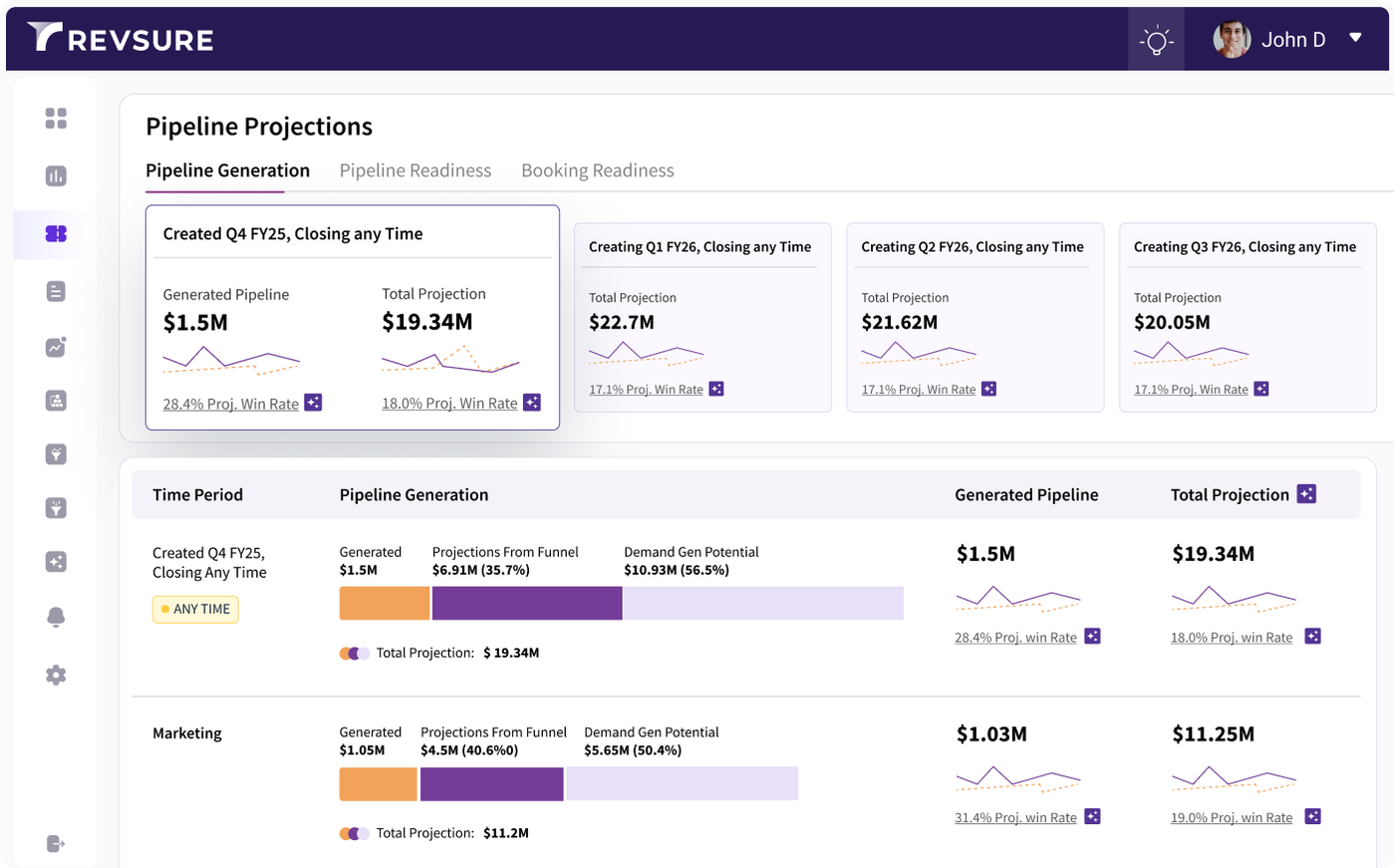
When combined with Marketing Mix Modeling, like RevSure’s AI-powered MMX, readiness can also be traced back to its main drivers. Changes in pipeline quality or conversion rates can be linked to shifts in spending, channel mix, and timing. For GTM leaders, this shows not just what’s happening in the funnel, but also why it’s happening.
This complete view helps leaders make better decisions about where to invest, when to step in, and how to adjust their strategy.
From Pipeline Generation to Revenue Confidence
Pipeline volume will always matter. Without enough new opportunities, growth stops. But volume alone doesn’t make results predictable.
Revenue confidence comes from knowing which parts of the pipeline are solid, which are fragile, and which need attention. This clarity comes from readiness, which measures probability, speed, and quality together instead of separately.
For B2B GTM leaders facing tighter budgets and more scrutiny, this shift is strategic. Strong quarters don’t come from the biggest pipelines. They come from pipelines that are ready, with deals that move forward steadily and show real buyer demand. Confidence is more valuable than just coverage.
In the end, revenue doesn’t depend on how much pipeline you generate. It depends on how much of that pipeline actually closes, and how reliably it happens.