On this page
Across this series, we’ve explored the structural shifts redefining go-to-market execution in the Agentic Era.
We began by examining the illusion of efficiency in “GTM Efficiency Is a Feeling. Cohesion Is a System,” where we looked at why many GTM teams feel productive while still struggling with inconsistent execution. We then explored how “Automation Executes Tasks. Agentic AI Executes Outcomes” explains the shift from workflow automation toward outcome-driven execution. In the following posts, we discussed why governance is becoming the permission structure for autonomy, and why integration is the missing middle between insight and action. Most recently, we explored how theGTM engine itself is becoming agentic, whether organizations are fully prepared for that transition or not.
Taken together, these shifts point to a deeper transformation. The defining advantage of high-performing GTM teams is changing.
For years, the competitive narrative in go-to-market execution centered around speed. Faster campaign launches, faster lead response times, faster pipeline growth. Speed became a proxy for operational excellence, and organizations invested heavily in tools and automation designed to move work forward more quickly.
But the environment in which GTM teams operate today is fundamentally different from the one where that strategy emerged.
Buying journeys now stretch across multiple channels, signals arrive continuously from dozens of systems, and decisions involve multiple stakeholders across marketing, sales, RevOps, and customer teams. In this environment, speed alone rarely creates an advantage. In many cases, isolated speed simply creates more noise.
The real differentiator is becoming something else. Coordination.
Why Speed Alone No Longer Creates Advantage
Speed mattered when the GTM engine was relatively linear. Marketing generated leads, sales pursued them, and success was measured by how efficiently those activities moved through the funnel.
Today’s reality is far more complex.
Signals now originate from a wide range of sources: website engagement, campaign interactions, third-party intent data, product usage, sales conversations, and customer lifecycle signals. Each of these inputs can provide insight into buyer readiness, account behavior, or opportunity health. But signals alone do not create outcomes. They only create value when they are interpreted and acted upon consistently across the entire GTM organization.
This is where many teams still struggle. The RevSure’s 2026 State of Agentic AI in B2B GTM research shows that even as teams describe their operations as efficient, structural barriers remain common. 47% of organizations still cite lead quality and data quality issues as primary constraints, while 36% struggle with inconsistent sales follow-up.
These problems are not primarily about speed. They are about coordination.
Marketing may generate strong engagement signals, but if those signals are not translated into clear sales priorities, they lose value. Sales teams may move quickly, but without context, they may focus on the wrong opportunities. Customer teams may detect early signs of churn or expansion potential, but if that insight is not connected to the broader GTM system, it arrives too late to change the outcome.
Speed amplifies activity. Coordination amplifies results.
The Rise of the Coordinated GTM System
Agentic AI is accelerating the need for coordination because it exposes how fragmented many GTM systems still are.
When AI agents begin interpreting signals and acting across systems, the need for shared context becomes immediate. Agents must understand how marketing signals translate into sales readiness, how pipeline signals connect to account engagement, and how product or customer signals influence opportunity outcomes.
This is why the research shows overwhelming confidence in the potential of full-funnel context. 96% of leaders believe AI agents with complete funnel visibility would significantly improve execution.
Full-funnel context is not simply a data capability. It represents an organizational model where decisions are coordinated across functions rather than isolated within them.
In coordinated GTM systems, signals move fluidly between teams. Marketing engagement informs sales prioritization. Sales activity feeds back into marketing strategy. Customer success signals shape expansion and retention decisions. RevOps governs the definitions, integrations, and performance metrics that keep the system aligned.
How Agentic AI Changes the Role of Every GTM Function
As Agentic AI becomes embedded in GTM operations, the role of each function begins to evolve.
Marketing leaders are increasingly moving beyond channel optimization toward full-funnel accountability. Campaign success is measured not only by engagement metrics but by the quality of pipeline those signals generate and their downstream impact on revenue.
Sales teams benefit from clearer prioritization. Agentic systems can interpret buying signals across the journey and surface accounts that demonstrate genuine readiness. This reduces guesswork and allows sellers to focus their efforts where they have the greatest impact.
Customer success teams gain earlier visibility into both expansion and risk signals. Instead of reacting after churn indicators appear, they can intervene proactively based on shifts in engagement, product usage, or buying group behavior.
At the center of this coordinated system sits RevOps. As Agentic AI becomes operational, RevOps plays an increasingly critical role as the steward of alignment. This includes governing data definitions, maintaining system integrations, and ensuring that AI-driven actions remain consistent with GTM goals.
Each function retains its specialized expertise, but success is no longer determined by isolated performance. It is determined by how effectively those functions operate together.
Coordination Requires Cohesion, Governance, and Integration
Throughout this series, three structural foundations have emerged repeatedly as prerequisites for coordinated execution.
The first is cohesion. Teams must operate from shared definitions of pipeline health, lead quality, and performance metrics. Without that alignment, signals degrade as they move between functions.
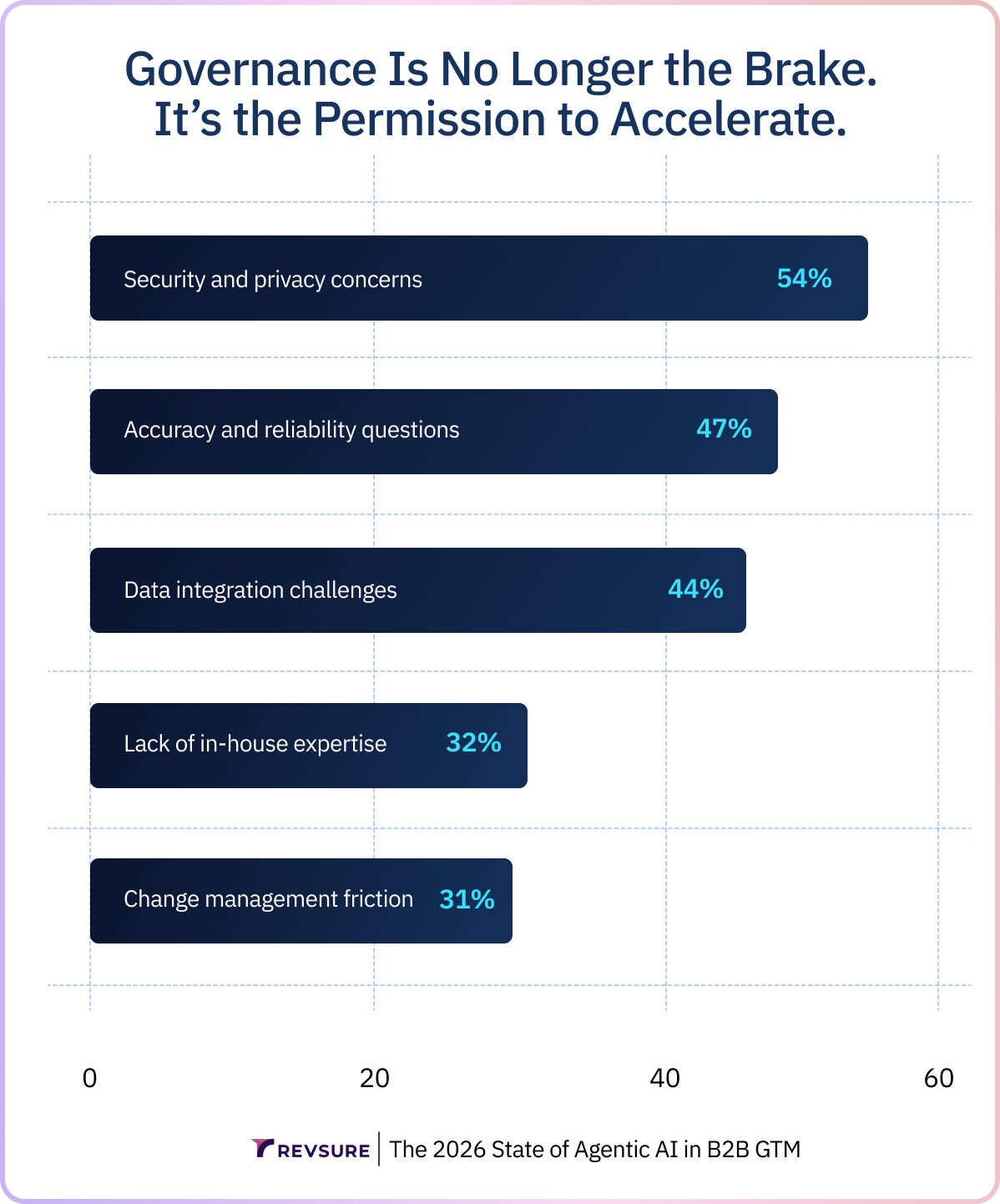
The second is governance. Autonomous systems require clear guardrails defining which actions can occur, how decisions are evaluated, and how outcomes are audited. As discussed in “Governance Is No Longer the Brake. It’s the Permission to Accelerate,” governance creates the trust that allows AI to participate in execution rather than merely advise it.
The third is integration. Systems must provide unified context across CRM, marketing automation, sales engagement, analytics, and customer platforms. As we explored in “Integration Is the Missing Middle Between Insight and Action,” AI agents cannot reason effectively when operating on fragmented data.
Together, these foundations create the conditions for coordination.
Without them, AI amplifies fragmentation. With them, AI amplifies alignment.
The Next Stage of GTM Performance
Agentic AI adoption is already moving quickly. According to the research, 76% of organizations are deploying or implementing Agentic AI, with 41% already using it and another 35% actively rolling it out.
At the same time, expectations for ROI are tightening. 86% of organizations expect measurable returns within 12 months, and 40% expect results within six months.
These expectations leave little room for disconnected execution. AI must produce tangible improvements in pipeline velocity, conversion rates, and cost-to-pipeline efficiency.
The organizations that achieve those outcomes will not simply be the ones that adopt AI first. They will be the ones that coordinate execution most effectively across the funnel.
In coordinated GTM systems, human teams and AI agents operate from the same context, follow the same governance rules, and pursue the same outcomes. Decisions reinforce each other rather than compete with each other. That alignment creates something GTM organizations rarely experience: clarity.
The Question Leaders Should Be Asking Now
The Agentic Era is not about adding AI to existing workflows. It is about building a GTM operating system where insight, decision-making, and execution flow continuously across teams and systems. The question leaders should ask is not whether their teams are working harder or faster. It is whether their systems allow marketing, sales, RevOps, and customer teams to move together with shared context and coordinated action. Because in the Agentic Era, speed alone is no longer the defining advantage. Coordination is.
—
Agentic AI is transforming how GTM teams interpret signals, prioritize opportunities, and execute across the funnel. The organizations that succeed will be those that build coordinated systems where human teams and AI agents operate with shared context and governance.
To explore the research behind these shifts—including adoption trends, readiness gaps, and the future of Agentic GTM, downloadThe 2026 State of Agentic AI in B2B GTM report.